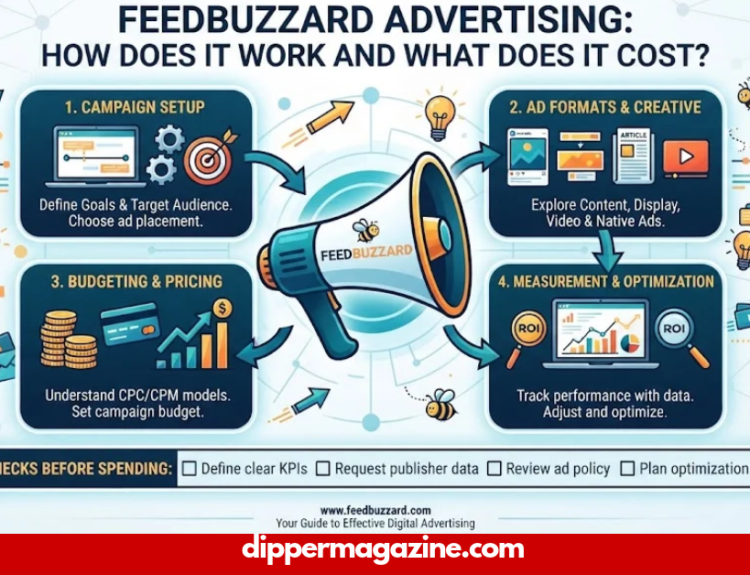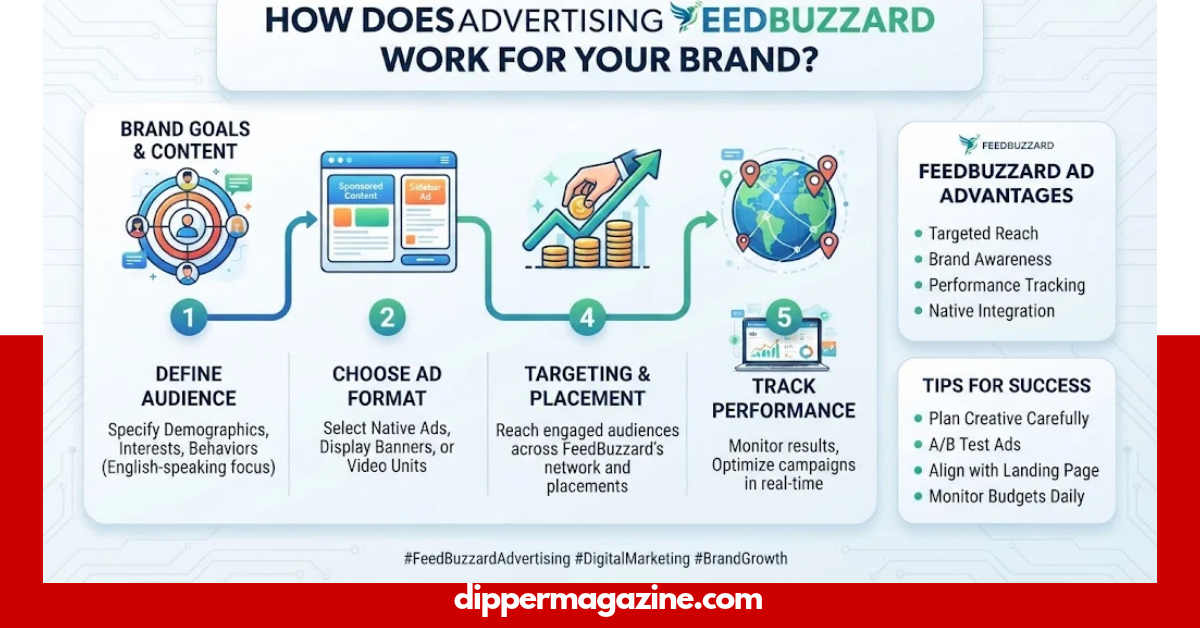
Advertising FeedBuzzard refers to using FeedBuzzard as a digital advertising channel to present promotional content to its audience. FeedBuzzard’s own advertising guide describes the platform as a way for advertisers to reach English-speaking audiences and manage campaigns with different targeting and advertising considerations.
For a business, the real value comes from matching the advertisement with the right audience, message, placement, and campaign goal. Instead of treating an ad as a simple banner, marketers can plan the creative, landing page, audience, budget, and tracking together.
Why Are Businesses Exploring Advertising FeedBuzzard?
A digital ad campaign can struggle when the message reaches people who have little interest in the product. The same campaign can perform differently depending on its audience, creative, placement, timing, and landing page.
Advertising FeedBuzzard gives marketers another channel to consider when they want to reach an English-speaking digital audience. FeedBuzzard’s published advertising material highlights audience reach, ad formats, targeting, budgeting, and campaign setup as important parts of the advertising process.
The key is not simply buying exposure. A useful campaign starts with a clear reason for advertising and a measurable action that visitors should take.
Who Can Use Advertising FeedBuzzard?
Different businesses can approach FeedBuzzard advertising for different reasons. The most suitable approach depends on the product, audience, budget, and campaign objective.
Potential advertisers include:
- E-commerce businesses
- SaaS companies
- Mobile and web applications
- Technology brands
- Online publishers
- Agencies
- Startups
- Consumer brands
- Service businesses
- Content and media companies
A company selling software, for example, may want visitors to start a free trial. An online store may want product-page visits, while a publisher may want newsletter subscriptions.
The campaign should therefore begin with the desired business action, not with the advertisement format.
What Advertising Goals Can You Set?
Before starting advertising feedbuzzard, decide what success means for your campaign. A campaign designed to generate awareness should not use the same measurement approach as one designed to generate purchases.
| Advertising Goal | Main Metric | Useful Supporting Metrics |
| Brand awareness | Reach | Impressions, frequency |
| Website traffic | Clicks | CTR, sessions |
| Lead generation | Leads | Conversion rate, CPL |
| Product sales | Purchases | CPA, revenue |
| App promotion | Installs | CPI, activation rate |
| Content promotion | Page visits | Engagement, time on page |
| Newsletter growth | Sign-ups | Conversion rate |
| Retargeting | Conversions | CPA, ROAS |
A clear objective makes campaign decisions easier. It also helps you decide whether an ad needs a stronger headline, a different audience, or a better landing page.
What Ad Formats Should You Consider?
FeedBuzzard’s published advertising guide discusses ad formats, placements, creative specifications, targeting, budgets, and pricing models.
The exact options available to an advertiser should be confirmed directly with FeedBuzzard before a campaign begins because advertising products and specifications can change.
Common digital advertising formats may include:
- Display advertisements
- Banner placements
- Sponsored content
- Promotional placements
- Native-style advertisements
- Campaign landing-page promotions
Each format serves a different purpose.
A display placement can support visibility, while a more content-focused placement can provide additional context before a visitor reaches the advertiser’s website.
How Do You Prepare an Ad Creative?
Good creative should communicate the offer quickly. A visitor should understand what the business offers and what action they can take without reading a long block of text.
A practical advertisement usually contains:
- A clear headline
- A short benefit
- Relevant visual content
- One primary call to action
- A useful destination page
For example, instead of using a vague headline such as “Discover Our Platform,” a software company could explain the benefit more clearly: “Create Your First Marketing Report in Minutes.”
The second version gives the visitor a reason to click.
How Does Audience Targeting Work?
Audience targeting helps advertisers focus their campaign on people who are more relevant to the product or service. FeedBuzzard’s advertising guide specifically identifies targeting as part of campaign planning.
Depending on the advertising options available, marketers may consider factors such as:
- Geographic market
- Language
- Audience interests
- Device type
- Content context
- Campaign intent
- Previous website activity
However, targeting should remain practical. A highly narrow audience can reduce reach, while an overly broad audience can send traffic to people who have little interest in the offer.
The right balance depends on the campaign objective and available audience data.
What Budget Should You Use for Advertising FeedBuzzard?
There is no universal budget that works for every advertiser. Your budget should reflect the campaign goal, expected traffic, conversion value, testing period, and available advertising inventory.
Instead of spending the entire budget immediately, businesses can divide it into stages:
| Campaign Stage | Purpose |
| Test | Identify promising audiences and creatives |
| Optimize | Improve weak campaign elements |
| Scale | Increase spending on proven combinations |
| Review | Compare results with the original goal |
For example, a business could test two different headlines before increasing its advertising spend.
FeedBuzzard’s published guide discusses budgeting and pricing models, but advertisers should confirm current rates and available options directly before purchasing a campaign.
How Can You Create a Better Landing Page?
An advertisement only starts the customer journey. The landing page completes the next step.
If an advertisement promises a free trial but sends visitors to a general homepage, the visitor may struggle to find the promised offer. This creates unnecessary friction.
A campaign landing page should:
- Match the advertisement’s message
- Load quickly
- Explain the main benefit
- Use one clear call to action
- Work well on mobile devices
- Make important information easy to find
- Avoid unnecessary distractions
The strongest campaign connection is simple:
Ad → Relevant landing page → Clear action
When these three parts support each other, visitors have a clearer path from the advertisement to the desired action.
How Should You Measure Advertising FeedBuzzard Results?
Measurement is one of the most important parts of advertising feedbuzzard. Impressions alone do not tell you whether a campaign achieved its business objective.
Track metrics that match your original goal.
Important advertising metrics
Impressions:
The number of times an advertisement is displayed.
Clicks:
The number of times users interact with the advertisement.
Click-through rate (CTR):
The percentage of impressions that result in clicks.
Conversion rate:
The percentage of visitors who complete the desired action.
Cost per click (CPC):
The amount paid for each click when using a CPC pricing model.
Cost per acquisition (CPA):
The advertising cost associated with obtaining a desired conversion.
Return on ad spend (ROAS):
Revenue generated compared with advertising spend when revenue tracking is available.
A campaign can receive many clicks but still produce poor business results if the landing page or offer fails to convert visitors.
How Can You Track Campaign Performance?
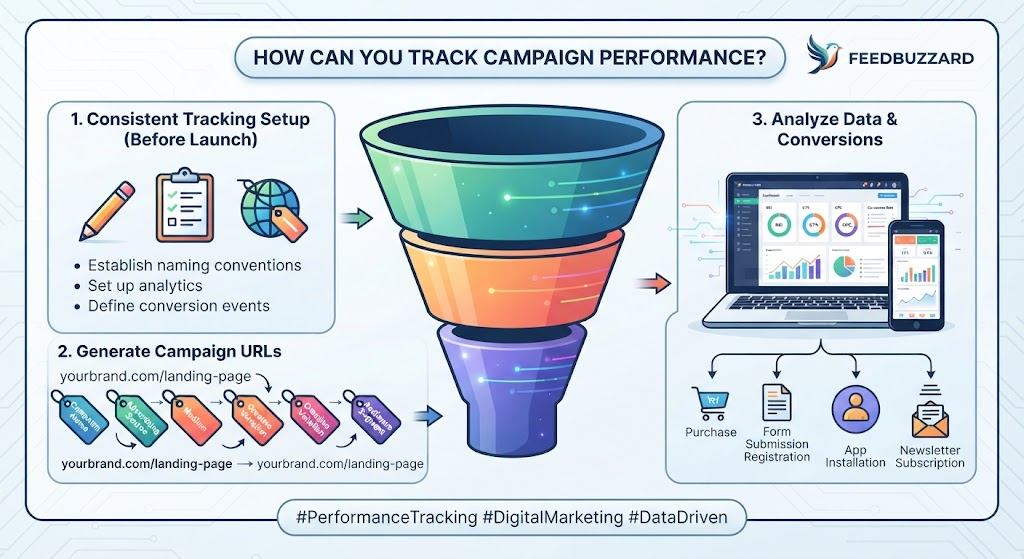
Use consistent tracking before launching the campaign. Website analytics and campaign-specific URL parameters can help identify where visitors came from and what they did after arriving.
For example, a campaign URL can contain tracking parameters for:
- Campaign name
- Advertising source
- Medium
- Creative variation
- Audience segment
Keep naming consistent across campaigns. Otherwise, your analytics data can become difficult to compare.
You should also define the conversion event before launch. A conversion might be a purchase, form submission, account registration, app installation, or newsletter subscription.
What Makes Advertising FeedBuzzard More Effective?
There is no single advertising trick that guarantees results. A stronger approach comes from testing several connected elements.
Focus on these areas:
1. Match the audience
Promote the product to people who have a reasonable reason to care about it.
2. Improve the message
Explain the customer benefit rather than only describing the product.
3. Use strong creative
Make the advertisement easy to understand at a glance.
4. Keep the landing page relevant
The page should deliver what the advertisement promised.
5. Test variations
Try different headlines, visuals, calls to action, or audience groups when the campaign setup allows it.
6. Review actual conversions
Clicks are useful, but completed business actions often provide more meaningful information.
Advertising FeedBuzzard vs. Other Digital Advertising Channels
Advertising feedbuzzard should not automatically replace other advertising channels. Businesses can compare it with search advertising, social media advertising, display networks, publisher placements, and other media based on their specific goals.
| Channel | Common Strength | Typical Goal |
| FeedBuzzard advertising | Publisher-based digital reach | Awareness and traffic |
| Search advertising | User search intent | Leads and sales |
| Social advertising | Audience targeting | Awareness and conversions |
| Display advertising | Broad visual reach | Awareness and remarketing |
| Email marketing | Existing audience | Retention and conversions |
| Content marketing | Organic discovery | Long-term traffic |
The right comparison depends on audience, cost, conversion value, and campaign objectives.
Do not judge a channel only by its traffic volume. A smaller audience that matches your product can sometimes provide more useful visitors than a large but poorly matched audience.
What Should You Ask Before Buying an Advertising Campaign?
Before committing a budget, ask the advertising provider for current campaign information.
Useful questions include:
- What advertising formats are currently available?
- What audience can the campaign reach?
- Which countries or markets are supported?
- What creative specifications are required?
- What minimum budget applies?
- What pricing models are available?
- How are impressions or clicks measured?
- Are campaign reports provided?
- What tracking options are supported?
- How long does campaign approval take?
- What advertising categories are restricted?
- What landing-page requirements apply?
FeedBuzzard’s published advertising material identifies campaign setup, formats, targeting, budgets, pricing, and creative specifications as important areas to review.
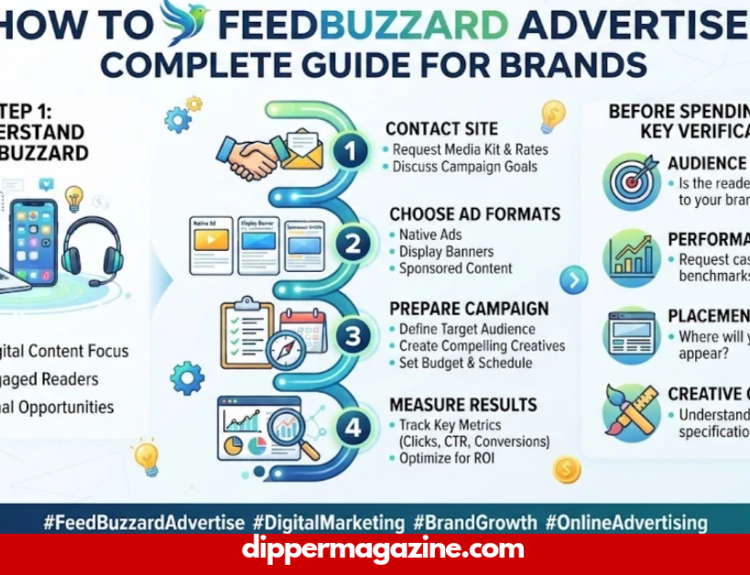
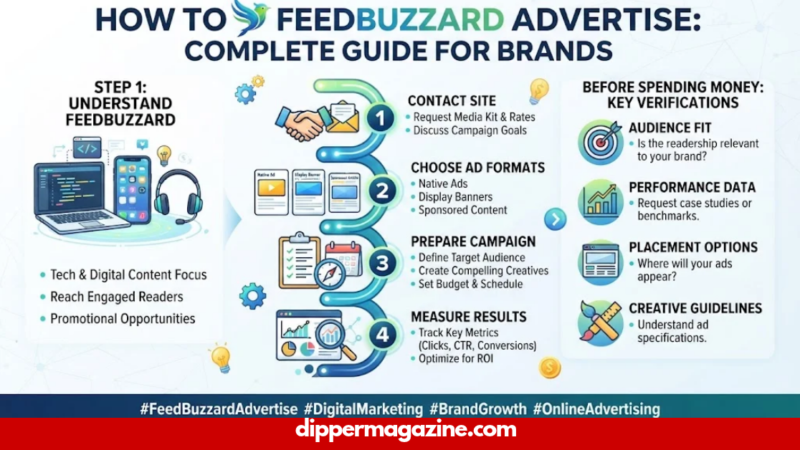
How Do You Start an Advertising FeedBuzzard Campaign?
The basic process can be organized into a simple checklist.
Step 1: Define your goal
Choose one main objective, such as traffic, leads, sales, or awareness.
Step 2: Identify your audience
Decide who should see the campaign and which markets matter.
Step 3: Prepare your creative
Create the required advertisement assets according to the current specifications.
Step 4: Build the landing page
Make sure the destination page matches the advertisement.
Step 5: Add tracking
Set up analytics and campaign parameters before sending traffic.
Step 6: Confirm campaign requirements
Check current pricing, placement, approval rules, and advertising policies with FeedBuzzard.
Step 7: Launch a controlled test
Start with a manageable budget when possible.
Step 8: Review the data
Look at clicks, conversions, costs, and user behavior.
Step 9: Improve the campaign
Keep the elements that perform well and revise weak ones.
Step 10: Scale carefully
Increase investment only when the campaign produces results that support the additional spend.
What Are the Common Mistakes to Avoid?
Even a well-funded campaign can waste money when basic planning is missing.
Using a vague message
Visitors should quickly understand the product and benefit.
Sending everyone to the homepage
A dedicated landing page often provides a clearer next step.
Measuring only impressions
Exposure matters, but it does not automatically mean business success.
Changing everything at once
If you change the audience, creative, landing page, and offer simultaneously, it becomes harder to identify what caused a performance change.
Ignoring mobile visitors
Many digital users browse on smartphones. Your advertisement and landing page should provide a good mobile experience.
Making unsupported promises
Advertising claims should accurately represent the product. Clear and truthful messaging protects both the customer experience and the advertiser’s reputation.
How Does Advertising FeedBuzzard Fit Into an SEO Strategy?
Paid advertising and SEO serve different functions.
Advertising can provide paid exposure, while SEO aims to earn visibility through organic search. A business can use both, but paid traffic does not automatically improve organic rankings.
Google’s current guidance emphasizes helpful, reliable, people-first content and warns against creating content primarily to manipulate search rankings.
For businesses using advertising feedbuzzard alongside SEO, the strongest approach is to make the destination page genuinely useful. The page should answer customer questions, explain the product clearly, provide trustworthy information, and make the next step easy.
Can Advertising FeedBuzzard Support Brand Awareness?
Yes, an advertising campaign can be designed around brand awareness when the objective is to introduce a company, product, service, or message to a relevant audience.
However, awareness should be measured differently from direct-response campaigns.
Useful awareness indicators can include:
- Reach
- Impressions
- Frequency
- Branded searches
- Direct website visits
- Engagement
- Assisted conversions
A visitor may not purchase during the first interaction. Brand campaigns can therefore require a longer measurement window than direct-response campaigns.
How Can You Make FeedBuzzard Advertising More Trustworthy?
Trust starts with the advertiser’s own website.
Before sending paid visitors to a page, make sure the site clearly explains:
- Who operates the business
- What the company offers
- How customers can contact the business
- Pricing or important terms where appropriate
- Privacy information
- Refund or cancellation policies where relevant
- Product limitations
- Customer support information
Google’s E-E-A-T guidance highlights experience, expertise, authoritativeness, and trustworthiness as important qualities for evaluating helpful content. Google also recommends making it clear why readers should trust information and providing appropriate background about the people or organization behind the content.
What Does Google Say About AI, SEO, and Helpful Content?
Google’s current guidance does not require a special “AI SEO” formula for appearing in AI features. Google says foundational SEO practices still apply, while unique, useful, reliable, people-first content remains important for both traditional Search and generative AI experiences.
That matters when creating content around advertising feedbuzzard. Repeating the keyword across dozens of thin pages is less useful than creating one comprehensive resource that answers real advertiser questions.
Google also states that content can use AI or automation, but content created primarily to manipulate search rankings can violate spam policies. Quality, originality, usefulness, and the reason the content exists matter more than simply claiming that content was written by a person.
Advertising FeedBuzzard: Quick Campaign Checklist
Use this checklist before launching:
- Define one primary campaign objective
- Identify the target audience
- Confirm available FeedBuzzard ad formats
- Check current advertising requirements
- Prepare suitable creative assets
- Write a clear advertisement message
- Build a relevant landing page
- Install or confirm analytics tracking
- Create campaign URL parameters
- Define the conversion event
- Confirm the campaign budget
- Review performance after launch
- Test improvements systematically
- Compare results against the original objective
This process helps prevent a common mistake: launching an advertisement before deciding how success will be measured.
Frequently Asked Questions
Answer: Advertising FeedBuzzard means using FeedBuzzard’s available advertising opportunities to promote a business, product, service, or message to its audience. FeedBuzzard’s published guide covers campaign formats, targeting, budgets, pricing, and setup.
Answer: Start by defining your campaign goal, audience, creative, landing page, tracking method, and budget. Then confirm the current advertising options and requirements directly with FeedBuzzard before launching.
Answer: Pricing depends on the advertising option, campaign setup, audience, and pricing model. Current rates should be confirmed with FeedBuzzard rather than relying on outdated third-party figures.
Answer: It can be considered by small businesses when the available audience matches their target market and the campaign economics make sense. Start with a controlled test when possible and measure actual business results.
Answer: Measure the metrics connected to your objective. These may include impressions, clicks, CTR, conversions, CPA, revenue, or ROAS when appropriate.
Answer: Paid advertising should not be treated as a direct way to improve organic Google rankings. SEO visibility depends on Google’s organic ranking systems, while advertising provides paid exposure. For organic visibility, focus on useful, original, trustworthy content and sound technical SEO.
Conclusion
Advertising FeedBuzzard can be approached as one part of a wider digital marketing plan rather than a standalone solution. The strongest campaigns begin with a clear objective, reach a relevant audience, use a focused message, send visitors to a useful landing page, and measure meaningful actions.
Before spending money, confirm FeedBuzzard’s current advertising formats, pricing, targeting options, creative requirements, and campaign policies. Then run a measured test and use the results to improve the campaign.
For SEO and AI search visibility, keep the same principle: create something genuinely useful for the person reading it. Google’s current guidance emphasizes original, valuable, people-first content rather than pages created mainly to capture search traffic.