A Python program that suddenly stops working can be frustrating, especially when the error message contains an unfamiliar term such as Oxzep7. Without the full message, it is difficult to know whether the problem comes from Python, a third-party library, or another application. Searching for the wrong solution can waste time or expose your computer to unsafe downloads. This guide explains how to investigate the python error oxzep7 software issue, identify the actual cause, and choose a safe, practical fix.
What Is Python Error Oxzep7 Software?
The phrase python error oxzep7 software is not a recognized name for a standard Python exception in the official Python documentation. The available public documentation does not establish Oxzep7 as a standard Python error code or a widely documented Python component.
Python normally reports specific exceptions, including ModuleNotFoundError, ImportError, SyntaxError, TypeError, and PermissionError. Each indicates a different type of problem. You should identify the actual exception before changing your installation or downloading additional software.
The word Oxzep7 could be a custom identifier used by an application, an unfamiliar program name, a mistyped message, or a label used by a website. The complete error message is needed to distinguish these possibilities.
Is Oxzep7 an Official Python Error Code?
There is no documented standard Python exception named Oxzep7 in the official built-in exceptions reference. However, a private application can use its own internal labels, so the absence of a standard exception does not prove that the term cannot appear in a particular program.
Check the message displayed on your screen and determine where the term appears. If it appears in a Python traceback, examine the exception name and surrounding lines. If it appears in a separate Windows notification, application log, or downloaded file name, investigate that source separately.
Do not assume that every error containing Oxzep7 has the same cause or requires the same repair.
What Causes the Python Error Oxzep7 Software Issue?
The underlying problem depends on the actual error. A Python application may fail because it cannot locate a required library, uses an incompatible package version, runs under the wrong interpreter, or encounters a problem in its source code.
A program may also stop unexpectedly because of a native extension, operating-system issue, or damaged installation. These possibilities require different troubleshooting methods.
Common possibilities to investigate include:
- Missing Python modules: A required package is not installed in the environment running the program.
- Version incompatibility: The application expects a different Python or library version.
- Incorrect interpreter: The terminal, editor, and application use different Python installations.
- Code errors: Invalid syntax, incorrect variable types, or unexpected input interrupts execution.
- File permissions: Python cannot access a required file or directory.
- Native application crashes: A compiled extension or another system component fails outside the usual Python exception-handling process.
These are general troubleshooting possibilities, not confirmed causes of the Oxzep7 label.
How to Identify the Real Error Message
Before applying a fix, capture the complete error. The final line of a Python traceback usually identifies the exception type and provides a message explaining what went wrong. Earlier lines show the sequence of function calls that led to the failure.
Follow these steps:
- Reproduce the error once, if it is safe to do so.
- Copy the complete traceback or take a screenshot of the original notification.
- Look for the exception name, file path, and line number.
- Note which application and Python version you were using.
- Check whether the problem started after an update, package installation, or configuration change.
For example, a message such as ModuleNotFoundError: No module named ‘requests’ points toward a missing importable module. It does not establish that Oxzep7 itself is a Python exception.
The official Python documentation explains how traceback information records the calls associated with an exception. Reviewing this information is a more reliable starting point than guessing from a search phrase.
How to Fix Python Error Oxzep7 Software Step by Step
Use the following troubleshooting sequence to investigate the python error oxzep7 software problem without making unnecessary changes to your computer.
Step 1: Check Your Python Installation
Open Command Prompt or PowerShell on Windows. Run:
python –version
If that command does not work, try:
py –version
A working command should display the installed Python version. If neither command works, Python may be missing, incorrectly configured, or unavailable through your system’s command path.
Download Python only from the official Python website if you need a fresh installation. Before reinstalling anything, confirm whether the application requires a particular Python version.
Step 2: Confirm Which Python Interpreter Runs the Program
Having Python installed does not guarantee that every application uses the same interpreter.
On Windows, run:
where python
On macOS or Linux, run:
which python3
If multiple paths appear, compare them with the interpreter selected in your code editor or application. An application may be using an environment that does not contain the packages installed elsewhere.
Select the correct interpreter before installing or removing dependencies.
Step 3: Check for Missing Modules
If the traceback contains ModuleNotFoundError, identify the missing module and the project that requires it.
For example, if your project specifically requires the requests package, you can install it using:
python -m pip install requests
Use the appropriate interpreter command for your system. On Windows, py -m pip install requests may be suitable when the Python launcher is configured.
Do not install a package merely because its name resembles Oxzep7. Confirm the dependency from the application’s official documentation or its trusted project files first.
Step 4: Create a Clean Virtual Environment
A virtual environment keeps a project’s Python packages separate from those used by other projects. This helps prevent accidental conflicts between dependencies.
Open a terminal in your project folder and run:
python -m venv .venv
Activate it on Windows:
.venv\Scripts\activate
On macOS or Linux, use:
source .venv/bin/activate
Install the dependencies listed in the project’s trusted requirements.txt file, if one exists:
python -m pip install -r requirements.txt
Then run the application again. A clean environment can help diagnose package conflicts, although it cannot fix every possible software or operating-system failure.
Step 5: Check Python and Package Compatibility
Some packages support only specific Python versions. Installing the newest version of a package or Python interpreter may not solve the problem if the application depends on older APIs or specific binary components.
Check the project’s documentation for its supported Python versions. Review the package requirements and recent changes before upgrading.
If the issue began immediately after a package update, test a compatible version in a separate virtual environment rather than changing the global installation.
Step 6: Review File Paths and Permissions
Python applications often read configuration files, write logs, access folders, or load data from specific locations. An incorrect path or restricted permission can interrupt execution.
Check whether the file exists and whether the account running Python can access it. Confirm that relative paths point to the expected working directory.
If the error mentions PermissionError, investigate the specific file or folder. Running every script as an administrator is not a safe default and can create additional security risks.
Step 7: Investigate Unexpected Application Crashes
Sometimes a Python application closes without showing a normal traceback. This may happen when a native extension or another system component fails.
If Windows displays the code 0xC0000005, Microsoft identifies it as an access violation involving an invalid memory address. That is a separate type of failure from a typical Python exception and may require application-specific debugging.
Check the application’s logs and Windows Event Viewer for the faulting module and exception details. Update or repair the affected application using its official installer if the evidence points to a damaged component.
Do not assume that every unexplained crash is caused by Oxzep7.
Common Python Errors and Their Meanings
Understanding the actual exception can help you choose the right repair instead of applying unrelated fixes.
| Error message | What it generally means | Recommended first step |
| ModuleNotFoundError | Python cannot locate an imported module. | Check the active interpreter and required package. |
| ImportError | An import operation could not load the requested component. | Check package compatibility and import names. |
| SyntaxError | Python cannot parse the source code. | Review the reported line and nearby syntax. |
| TypeError | An operation received an unsuitable type of value. | Check function arguments and variable types. |
| FileNotFoundError | A requested file or directory could not be found. | Verify the path and working directory. |
| PermissionError | An operation was denied because of access restrictions. | Review file permissions and ownership. |
| MemoryError | An operation could not obtain the required memory. | Check memory usage and the size of the operation. |
| 0xC0000005 | Windows reports an access violation. | Investigate the crashing application and fault details. |
The descriptions above summarize common meanings; the exact cause still depends on the traceback, code, and operating environment.
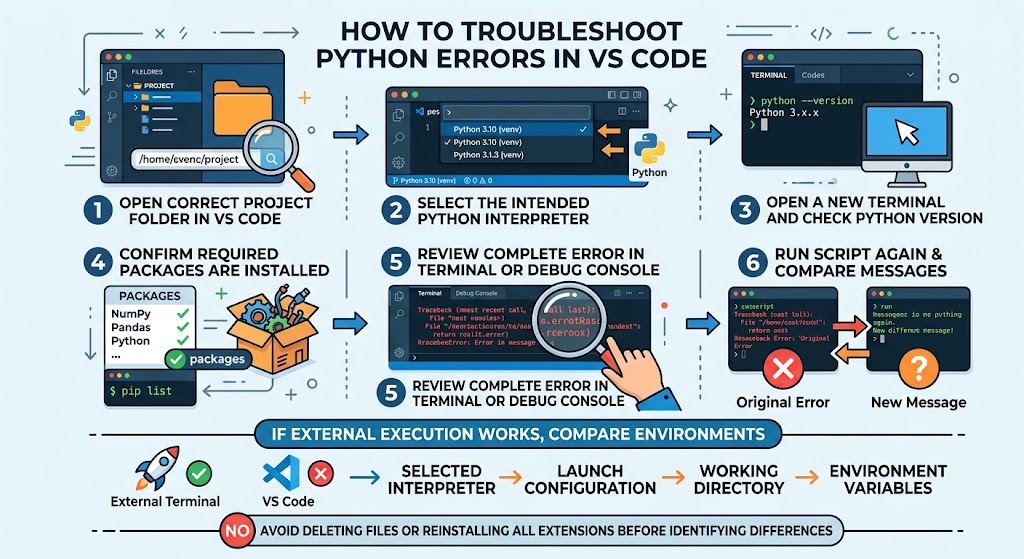
How to Troubleshoot Python Errors in VS Code
Visual Studio Code can run Python through a selected interpreter, virtual environment, or project-specific configuration. If a program works in one terminal but fails in VS Code, compare the environments before changing the code.
Try these checks:
- Open the correct project folder in VS Code.
- Select the intended Python interpreter using the Python extension’s interpreter-selection command.
- Open a new terminal and check the Python version.
- Confirm that the required packages are installed in that environment.
- Review the complete error in the terminal or Debug Console.
- Run the script again and compare the new message with the original one.
If the project works outside VS Code but fails inside it, inspect the selected interpreter, launch configuration, working directory, and environment variables.
Avoid deleting project files or reinstalling all extensions before identifying the difference between the two environments.
How to Check Whether Oxzep7 Software Is Safe
If Oxzep7 appears as the name of an application, executable, installer, or downloadable repair utility, verify the file before running it.
The phrase alone does not establish whether a particular file is legitimate or malicious. Its source, publisher, digital signature, behavior, and security scan results provide more useful evidence.
Use these precautions:
- Download Python and its official releases from trusted sources.
- Check the publisher and digital signature of unfamiliar Windows executables.
- Scan suspicious files with your installed security software.
- Avoid installing unknown packages through pip simply to remove an error message.
- Never disable antivirus protection permanently because an unofficial guide recommends it.
- Do not grant remote access to an unknown person promising an instant repair.
If you already downloaded a suspicious file, do not open it to test whether it works. Scan it first and remove it if your security software identifies a threat.
How to Prevent Similar Python Errors in the Future
A few development habits can reduce common Python configuration problems and make future errors easier to diagnose.
Keep project dependencies organized. Record required packages in a requirements.txt file or the dependency-management format used by your project.
Use separate virtual environments. Keep unrelated projects from sharing conflicting package versions.
Test updates before applying them to important projects. A package update may change behavior or introduce compatibility issues.
Keep useful error logs. Record the full traceback, Python version, package versions, and steps that reproduce the problem.
Back up working configurations. Keep a copy of important project files and dependency definitions so you can restore a known working setup.
Use trusted documentation. Consult the official Python documentation, the package maintainer’s instructions, and your application’s support resources before running unfamiliar commands.
These practices cannot prevent every crash, but they make troubleshooting more systematic and reduce the risk of unnecessary changes.
Troubleshooting Checklist for Python Error Oxzep7 Software
Use this checklist to work through the problem in a logical order.
- Capture the complete original error message.
- Identify whether the error appears in Python, an editor, or a separate application.
- Check the installed Python version.
- Confirm that the correct interpreter is selected.
- Read the traceback and identify the actual exception.
- Verify required packages and their supported versions.
- Test the project in a clean virtual environment when appropriate.
- Check file paths, permissions, and application logs.
- Investigate Windows crash details if the program closes without a traceback.
- Avoid unknown repair tools and unverified package installations.
If the issue remains unresolved, collect the exact error text and the steps that trigger it. Those details will make further diagnosis much more accurate.
Frequently Asked Questions
The phrase is not a recognized standard Python exception in the official built-in exceptions documentation. It may be an application-specific label, an unfamiliar software name, or a search phrase describing a different underlying problem. The full error message is necessary to determine its meaning.
Start by copying the complete error message and identifying the actual exception. Check the Python version, selected interpreter, and required packages. Apply a fix that matches the evidence instead of downloading an unknown repair utility.
The available public documentation does not establish Oxzep7 as a standard Python component or a widely documented package. Before installing anything with that name, verify its publisher, source repository, documentation, and purpose.
Reinstalling Python may help if the installation is damaged or incomplete. It will not necessarily fix a missing dependency, incorrect file path, incompatible package, or application bug. Diagnose the actual failure before reinstalling.
A virtual environment isolates a project’s installed packages from those of other projects. It can reduce dependency conflicts and make testing easier, but it cannot prevent every syntax error, application crash, or operating-system problem.
Provide the complete error message, Python version, operating system, application name, and the command or action that triggered the problem. Include the relevant traceback and recent changes, but remove passwords, API keys, access tokens, and other private information before sharing logs.
Conclusion
The most useful way to investigate the python error oxzep7 software issue is to identify what the computer actually reports. The term itself does not establish a specific Python exception, and different underlying problems require different solutions.
Start with the full traceback, verify your Python interpreter, check dependencies, and test changes in a controlled environment. If the message refers to a separate application or Windows crash, investigate that component rather than assuming Python itself is responsible.
Still seeing the error? Share the exact error message or a screenshot, along with your Python version and the application you were using. These details can help narrow down the cause and identify the next troubleshooting step.