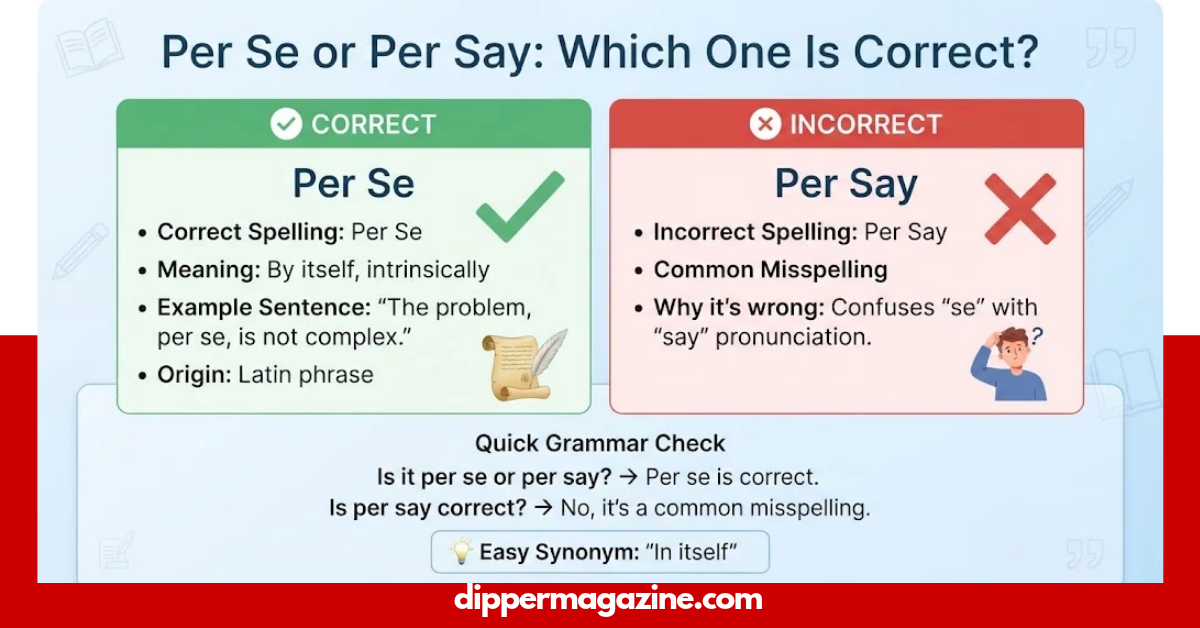
The correct spelling is per se, not per say. The confusion comes from pronunciation because se sounds like “say” in the common English pronunciation. Per se is a Latin phrase meaning “by itself,” “in itself,” or “intrinsically.”
If you are writing an email, essay, article, business document, or academic paper, use per se. Although per say appears in informal writing, it is considered a misspelling of the established phrase.
Quick Answer
| Question | Answer |
| Is it per se or per say? | Per se is correct. |
| Is per say correct? | No, it is a common misspelling. |
| What does per se mean? | By itself, in itself, or intrinsically. |
| What language is it from? | Latin |
| How is it pronounced? | Commonly /pɝː ˈseɪ/ in American English |
| Can I use it in formal writing? | Yes |
| What is an easy synonym? | In itself |
What Does Per Se Mean?
Per se means “by itself” or “in itself.” You use it when you want to talk about something on its own rather than everything connected to it.
For example:
The job is not difficult per se, but the long hours can be tiring.
Here, the speaker is not saying the job is difficult by its basic nature. The problem comes from the long working hours.
Cambridge Dictionary defines per se as “by or of itself,” while Collins explains it as referring to the qualities of something considered on its own.
Why Do People Write Per Say?
The main reason is pronunciation.
In common English pronunciation, per se sounds close to “per say.” Cambridge lists the American pronunciation as /pɝː ˈseɪ/ and the British pronunciation as /ˌpɜː ˈseɪ/.
Because writers often spell unfamiliar words according to how they sound, per say became a common spelling mistake.
The important point is simple: the sound may resemble “say,” but the written phrase is “per se.”
Per Se vs. Per Say: Complete Comparison
| Feature | Per Se | Per Say |
| Correct spelling | Yes | No |
| Meaning | By itself; in itself | No standard meaning as this phrase |
| Origin | Latin | Not the correct form of the phrase |
| Common use | Formal and general writing | Common spelling error |
| Pronunciation | Usually sounds like “per say” | Same intended sound |
| Example | The rule is not unfair per se. | Incorrect |
| Use in an essay | Yes | No |
| Use in professional writing | Yes | No |
The difference is mainly spelling, not pronunciation. Dictionary.com specifically identifies per se as the correct form and explains that “per say” is influenced by the pronunciation of se.
What Is the Origin of Per Se?
Per se comes directly from Latin. Its literal sense is “by itself.”
Dictionary.com traces the phrase to Latin per sē, meaning “by itself,” and dates its first English use to the 1500s.
The two parts also help explain the meaning:
- per = by or through
- se = itself
English has retained the original Latin spelling even though the phrase is now common in English writing.
This is why the spelling is per se, rather than the sound-based per say.
How Do You Pronounce Per Se?
The usual pronunciation sounds similar to “per say.”
Cambridge gives these pronunciations:
- American English: /pɝː ˈseɪ/
- British English: /ˌpɜː ˈseɪ/
The pronunciation explains why people often type per say when they hear the expression.
However, pronunciation does not change the spelling. When you write the phrase, use per se.
How Do You Use Per Se in a Sentence?
Per se usually appears after the noun or idea being discussed.
Here are simple examples:
- The movie was not bad per se, but it was too long.
- I do not dislike coffee per se; I just prefer tea.
- The product is not expensive per se, but shipping costs are high.
- She is not unfriendly per se; she is simply quiet.
- The plan is not impossible per se, but it needs more time.
- The issue is not technology per se, but how people use it.
- He is not a writer per se, although he publishes regularly.
- The restaurant is not cheap per se, but the portions are large.
In each example, the phrase separates the thing itself from another quality, condition, or surrounding factor.
Per Se Sentence Examples for Everyday English
The expression becomes easier to understand when you see it in ordinary situations.
Example 1: Food
I do not dislike vegetables per se, but I do not like boiled broccoli.
The speaker does not reject vegetables in general. The dislike applies to a particular preparation.
Example 2: Work
The job is not stressful per se, but the deadline is very tight.
The job itself is not necessarily stressful. The deadline creates the pressure.
Example 3: Weather
Cold weather is not unpleasant per se, but driving in heavy snow can be difficult.
The focus is on cold weather itself rather than its possible effects.
Example 4: School
Mathematics is not difficult per se, but the advanced topics require practice.
The subject itself is not being called impossible. The speaker is separating mathematics from the effort required to master advanced material.
Where Should You Put Per Se in a Sentence?
You can place per se in several natural positions, but it commonly follows the noun, adjective, or concept being discussed.
Common Pattern
Noun + per se
The price per se is not the problem.
Another Pattern
Adjective + per se
The idea is not unreasonable per se.
Contrast Pattern
Not + noun + per se + but…
It is not the cost per se, but the lack of value that concerns me.
This contrast structure is especially useful because it shows exactly what the writer means.
Collins provides similar examples where the phrase distinguishes an object or idea from the circumstances surrounding it.
When Should You Use Per Se?
Use per se when you want to focus on something independently from related circumstances.
It works especially well when you want to make a careful distinction.
Use it when:
- You mean “in itself.”
- You mean “by itself.”
- You want to separate an idea from its consequences.
- You are discussing the basic nature of something.
- You want to clarify that your criticism or praise does not apply to the thing itself.
Example
I am not against online shopping per se; I simply prefer buying certain products in person.
The speaker is not opposed to online shopping itself. The preference concerns particular products or situations.
When Should You Avoid Per Se?
Although per se is correct, you do not need to use it in every sentence.
For simple writing, alternatives can often sound clearer.
Instead of:
The rule is not confusing per se.
You could write:
The rule itself is not confusing.
Instead of:
The problem is not the price per se.
You could write:
The price itself is not the problem.
For beginner-friendly content, itself, in itself, and by itself may be easier to understand.
Per Se vs. Itself: What Is the Difference?
The two expressions often communicate a similar idea, but they have different styles.
| Expression | Meaning | Style |
| Per se | In itself | Formal |
| Itself | The thing itself | Neutral |
| In itself | Considered alone | Neutral/formal |
| By itself | Alone or independently | Common |
| Intrinsically | By its essential nature | Formal |
For example:
The idea is not bad per se.
You could also say:
The idea itself is not bad.
The second version is simpler and may work better for general readers.
Common Mistakes With Per Se
1. Writing “Per Say”
Incorrect:
The plan is not difficult per say.
Correct:
The plan is not difficult per se.
2. Writing “Persee”
Incorrect:
It is not harmful persee.
Correct:
It is not harmful per se.
The phrase contains two separate words.
3. Writing “Perse”
Incorrect:
The product is not expensive perse.
Correct:
The product is not expensive per se.
Perse can appear as a separate English word with unrelated meanings, including a deep grayish-blue color, so it should not be used as a replacement for the Latin phrase.
4. Using It Without a Clear Contrast
A sentence can technically contain per se but still sound unnecessary.
For example:
The blue shirt is blue per se.
This does not add useful meaning.
A clearer use would be:
The shirt is not expensive per se, but the imported fabric makes it costly.
Is Per Se Formal or Informal?
Per se is generally associated with formal or educated written English, although people also use it in everyday conversation.
Cambridge labels it as a formal adverb.
You may see it in:
- Academic writing
- Business writing
- Legal writing
- Journalism
- Essays
- Professional discussions
- Everyday conversation
For very simple writing, itself or in itself may be easier for the reader.
Is Per Say Ever Correct?
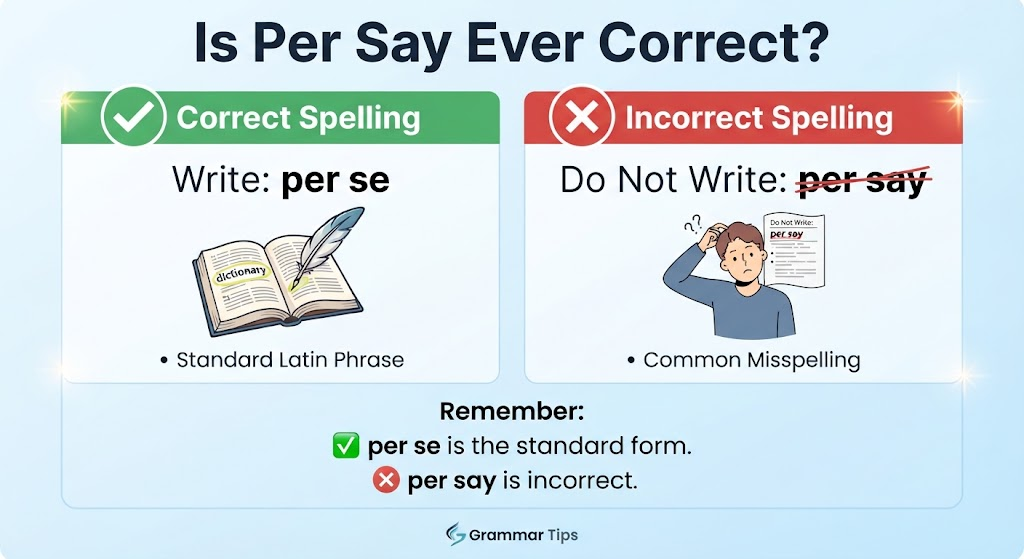
When someone intends the Latin phrase meaning “by itself,” per say is not the standard spelling.
The established expression is per se. Dictionary.com directly addresses the spelling confusion and explains that “per say” is a common misspelling caused by pronunciation.
So remember:
Write: per se
Do not write: per say
How Can You Remember the Correct Spelling?
A simple memory trick can help:
Think Latin, not sound.
The phrase comes from Latin per se, so keep the original spelling.
Another easy trick is:
Se = itself, not “say.”
When you hear “per say,” pause before writing it. Ask yourself whether you mean “by itself.” If the answer is yes, write per se.
What Are the Best Synonyms for Per Se?
Depending on your sentence, you can replace per se with several expressions.
| Per Se Synonym | Example |
| In itself | The idea is not harmful in itself. |
| By itself | The tool is not dangerous by itself. |
| Itself | The product itself is affordable. |
| Essentially | The problem is essentially about timing. |
| Intrinsically | The material is not intrinsically valuable. |
| As such | The rule is not unfair as such. |
| In essence | In essence, the two ideas are similar. |
Not every synonym works perfectly in every sentence. In itself is often the closest simple replacement.
Per Se in Academic and Professional Writing
Per se can work well in academic and professional writing when you need to make a precise distinction.
For example:
The study does not show that social media use per se causes the reported outcome.
This construction separates social media use itself from other factors that may accompany it.
Still, clarity should come first. If itself communicates the same idea more naturally, using the simpler word may make your sentence easier to read.
Per Se in Legal Writing
The phrase appears frequently in legal language because legal writing often distinguishes an action or condition from its specific circumstances.
For example:
The conduct is not unlawful per se.
This means the conduct is not automatically unlawful simply because of its nature; whether it is unlawful may depend on additional facts or legal rules.
The exact legal meaning always depends on the relevant law and context, so writers should not treat per se as a universal legal conclusion.
Is “Per Se or Per Say” a Common Spelling Question?
Yes. The confusion is understandable because the phrase is pronounced similarly to “per say.”
The spelling becomes easier once you know the phrase comes from Latin and means “by itself.” Dictionary.com specifically describes per say as a common misspelling, while Cambridge and Collins list per se as the established expression.
If you are checking a document, replace per say with per se when the intended meaning is “in itself.”
Quick Grammar Guide
| Question | Correct Answer |
| Per se or per say? | Per se |
| Per se meaning? | By itself or in itself |
| Per se origin? | Latin |
| Per se pronunciation? | Similar to “per say” |
| Is per say a standard spelling? | No |
| Is per se formal? | Yes, generally |
| Can per se be used in essays? | Yes |
| Can per se be used in conversation? | Yes |
| Is perse the same phrase? | No |
| Simple synonym? | Itself / in itself |
Frequently Asked Question
Per se is the correct spelling when you mean “by itself” or “in itself.” Per say is a common misspelling caused by the pronunciation.
It means “by itself,” “in itself,” or “considered on its own.” It helps separate something from other factors connected to it.
The final word se is commonly pronounced like “say,” which makes the spelling easy to confuse. Cambridge lists the common English pronunciation with a final /seɪ/ sound.
Yes. Per se comes from Latin and means “by itself.” English has retained the Latin spelling.
Yes. It is commonly used in academic, professional, legal, and other formal writing. However, itself or in itself can sometimes make a sentence clearer for general readers.
A simple example is:
The book is not difficult per se, but it contains many technical terms.
This means the book itself is not inherently difficult; the technical language creates the challenge.
Conclusion
If you are wondering whether to write per se or per say, choose per se when you mean “by itself” or “in itself.” The pronunciation can sound like “per say,” but the established spelling comes from the Latin phrase per se.
The easiest rule is:
Correct: per se
Common misspelling: per say
Once you connect per se with the meaning “in itself,” the spelling becomes much easier to remember. For simple audiences, you can also replace it with itself, in itself, or by itself when that makes your sentence clearer..