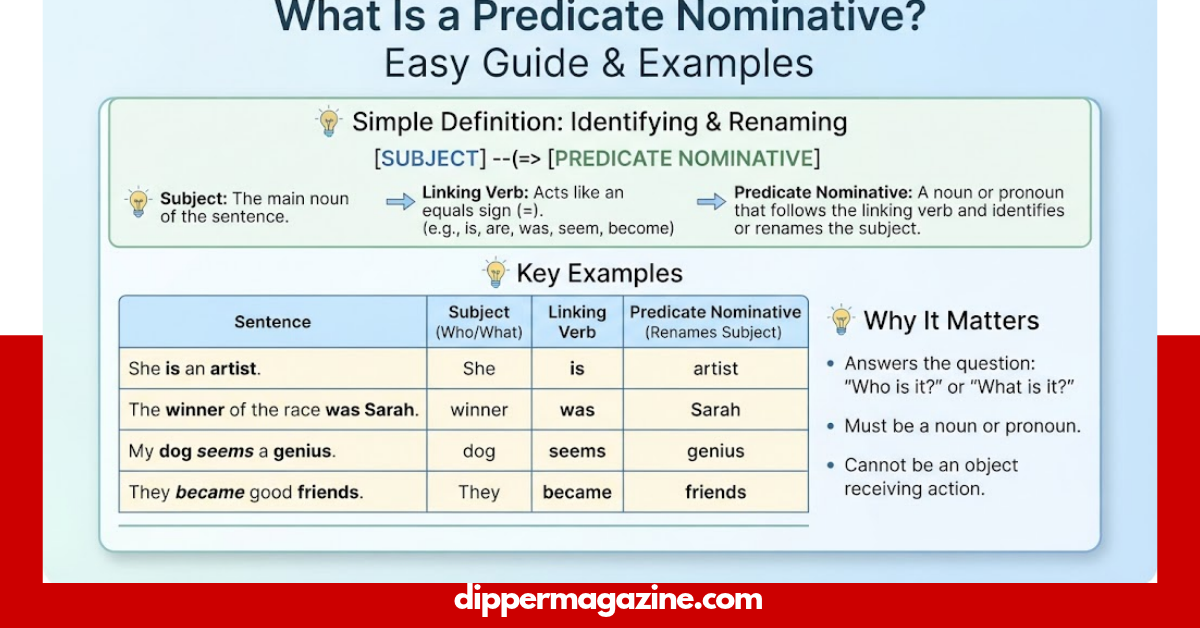
A predicate nominative can look confusing because it appears after a verb, yet it does not receive an action. It identifies or renames the subject and usually follows a linking verb such as is, are, was, were, become, or seem. Once you learn the simple connection between the subject and the word that follows the linking verb, this grammar idea becomes much easier to spot, explain, and use.
What Is a Predicate Nominative?
A predicate nominative is a noun, pronoun, or noun phrase that follows a linking verb and identifies or renames the subject. In simple terms, the subject and the predicate nominative refer to the same person, place, animal, thing, or idea.
For example:
- Maria is a doctor.
- My brother became the captain.
- That building is our school.
In “Maria is a doctor,” Maria and doctor point to the same person. The verb is does not show an action. Instead, it links Maria with doctor.
Grammar references often connect this structure with the broader idea of a subject complement. Cambridge Dictionary explains that a subject complement gives more information about the subject and commonly follows linking verbs. Dictionary.com also defines a predicate noun as a noun in the predicate that has the same referent as the subject after a copulative verb.
How Does a Predicate Nominative Work?
The easiest way to understand a predicate nominative is to look for a linking verb and then ask whether the word after it identifies the subject.
Use this basic pattern:
Subject + linking verb + predicate nominative
Example:
Sarah + is + the winner.
Sarah is the winner. The two noun phrases identify the same person, so “the winner” functions as the predicate nominative.
A useful test is the equals test. Replace the linking verb with an equals sign in your mind:
Sarah = the winner.
If that relationship makes sense, you may have found a predicate nominative.
Which Verbs Can Introduce a Predicate Nominative?
The verb to be introduces many examples, including:
- am
- is
- are
- was
- were
- be
- being
- been
Other linking verbs can also connect the subject to a complement when they describe a state or identity rather than an action. Common examples include become, remain, seem, and appear. Depending on context, verbs such as look, feel, smell, sound, and taste can also work as linking verbs.
Examples:
- Omar became the team leader.
- The child remained the class monitor.
- Her dream is a career in medicine.
- The soup smells wonderful.
The last example does not contain a predicate nominative because “wonderful” is an adjective. It is a predicate adjective. This distinction matters when you analyze the sentence.
What Are Examples of a Predicate Nominative?
Here are clear examples that show how the structure works:
| Sentence | Subject | Linking Verb | Complement |
| Ali is a teacher. | Ali | is | a teacher |
| My sister became the captain. | My sister | became | the captain |
| That woman is our manager. | That woman | is | our manager |
| The winners were Sara and Hina. | The winners | were | Sara and Hina |
| His goal is a scholarship. | His goal | is | a scholarship |
| My favorite place is the library. | My favorite place | is | the library |
In each sentence, the final noun or noun phrase identifies the subject. That shared identity is the key clue.
Predicate Nominative vs. Direct Object
One of the most common grammar mistakes is treating every noun after a verb as an object. A predicate nominative does not receive an action. A direct object does.
Compare these two sentences:
Ayesha is a student.
“Student” identifies Ayesha, so it is a predicate nominative.
Ayesha reads a book.
“Book” receives the action of reads, so it is a direct object.
The verb type gives you an important clue. Linking verbs connect the subject to information about the subject, while action verbs can take direct objects.
| Feature | Predicate Nominative | Direct Object |
| Follows | Usually a linking verb | Usually an action verb |
| Role | Identifies or renames the subject | Receives the action |
| Same identity as subject? | Yes | No |
| Example | Daniel is a pilot. | Daniel flies a plane. |
| Key question | Who or what is the subject? | Who or what receives the action? |
Cambridge Dictionary makes the same basic distinction between subject complements and objects. In “He became a famous writer,” the complement describes the same person as the subject, while in “He married a famous writer,” the noun phrase refers to a different person and functions as the object.
Predicate Nominative vs. Predicate Adjective
A predicate nominative is usually a noun or noun phrase. A predicate adjective describes the subject with an adjective.
Compare:
- Nina is a teacher. → “teacher” is a predicate nominative.
- Nina is patient. → “patient” is a predicate adjective.
- The sky became darkness. → “darkness” is a predicate nominative.
- The sky became dark. → “dark” is a predicate adjective.
Both structures use linking verbs, but they do different jobs.
A quick rule helps:
Noun or noun phrase that identifies the subject = predicate nominative.
Adjective that describes the subject = predicate adjective.
Cambridge Dictionary explains that subject complements can take different forms, including noun phrases and adjective phrases.
Can Pronouns Be Predicate Nominatives?
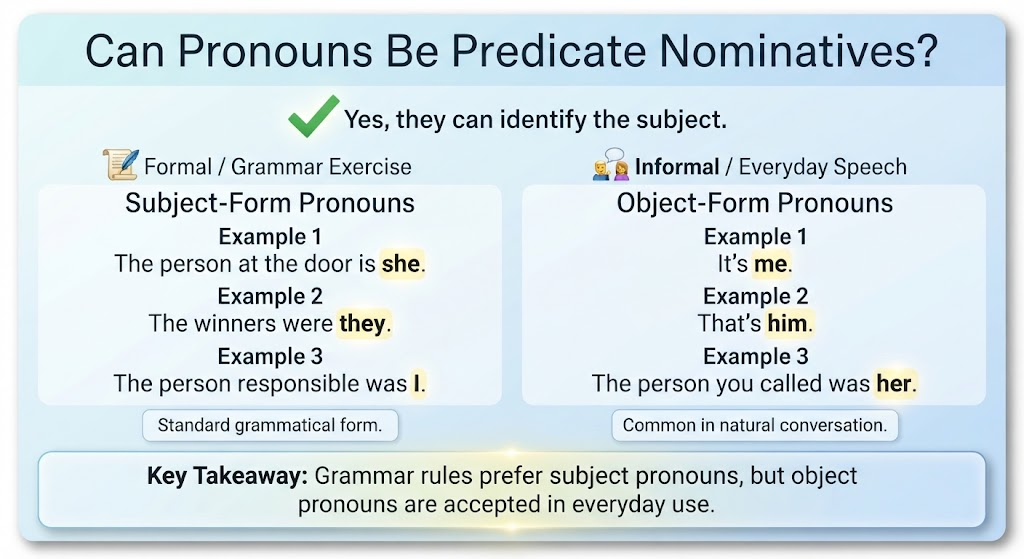
Yes. A pronoun can function as a predicate nominative when it identifies the subject.
For example:
- The person at the door is she.
- The winners were they.
- The person responsible was I.
However, everyday English often uses object-form pronouns after be, especially in informal speech:
- It’s me.
- That’s him.
- The person you called was her.
Cambridge Dictionary notes that object pronouns are common after be in ordinary English, while subject pronouns can appear in more formal contexts. This means grammar exercises may prefer forms such as “It was I,” while natural conversation commonly uses “It was me.”
How Do You Find a Predicate Nominative in a Sentence?
Finding a predicate nominative becomes simple when you follow a short process.
Step 1: Find the subject
Ask who or what the sentence is about.
Lina is the winner.
The subject is Lina.
Step 2: Find the verb
The verb is is.
Step 3: Decide whether the verb links the subject to information
“Is” connects Lina with “the winner.” It does not describe an action.
Step 4: Check the word after the verb
“The winner” identifies Lina.
Step 5: Use the equals test
Lina = the winner.
That confirms the relationship.
This method works especially well for students who confuse complements with objects.
What Is a Predicate Nominative in a Question?
The same grammar pattern can appear in questions, even when the word order changes.
Examples:
- Who is your teacher?
- What is the problem?
- Who was the winner?
- What became the main issue?
In “Who is your teacher?”, “teacher” identifies the subject who. In “What is the problem?”, “problem” identifies the subject what.
The key is not sentence order. Look at the relationship between the subject, linking verb, and complement.
Predicate Nominative with Compound Subjects
A sentence can contain a compound subject and still use this structure.
Example:
Sara and Hina are the class leaders.
“Sara and Hina” is the compound subject. “The class leaders” identifies them, so it functions as the predicate nominative.
Another example:
My brother and cousin became the organizers.
The noun phrase “the organizers” identifies the two people named in the subject.
When a sentence contains several nouns, do not automatically label the last noun as an object. First identify the verb and determine whether it links or expresses an action.
Predicate Nominative with Compound Complements
A sentence may also have more than one predicate noun.
Example:
The winners were Ali and Ahmed.
The phrase “Ali and Ahmed” identifies the winners. The entire phrase functions as the predicate nominative.
Another example:
Her favorite subjects are science and history.
“Science and history” identify the subjects she likes most. Together, they form a compound complement.
This pattern is useful when analyzing longer sentences because the complement can contain two or more nouns joined by and or or.
Common Mistakes Students Make
Understanding the definition is only part of the skill. Students often make the same mistakes when identifying this grammar structure.
Mistake 1: Calling Every Noun After a Verb an Object
A noun after a verb is not automatically a direct object. Ask whether the verb shows an action and whether the noun receives that action.
Mistake 2: Ignoring the Linking Verb
The linking verb is one of the strongest clues. Look for forms of be and other verbs that connect the subject to a description or identity.
Mistake 3: Confusing a Predicate Nominative with a Predicate Adjective
Check the word type. A noun or noun phrase that identifies the subject is different from an adjective that describes it.
Mistake 4: Using Only the “Comes After the Verb” Rule
Position alone does not identify the function. Meaning and verb type matter too.
Mistake 5: Forgetting Noun Phrases
A complement does not have to be one word. It can be a longer noun phrase, such as “the new school principal” or “the winner of the science competition.”
Why Is a Predicate Nominative Important?
Learning this grammar concept helps students understand how sentences are built. It also makes it easier to distinguish linking verbs, direct objects, subject complements, and predicate adjectives.
For writers, this knowledge improves sentence analysis and grammar accuracy. For teachers and students, it provides a clear way to explain why a noun after is or became can have a different grammatical role from a noun after an action verb.
Predicate Nominative Quick Reference Table
| Question | Quick Answer |
| What is a predicate nominative? | A noun, pronoun, or noun phrase that identifies or renames the subject after a linking verb. |
| Does it receive an action? | No. |
| Does it refer to the same person or thing as the subject? | Usually yes. |
| What verb often introduces it? | A form of “be.” |
| Can “become” introduce one? | Yes, when it links the subject to an identity or role. |
| Can an adjective be one? | No. An adjective functions as a predicate adjective. |
| Can a pronoun be one? | Yes. |
| Can it contain several words? | Yes. A full noun phrase can function as one. |
| What is the easiest test? | Try the “equals” relationship between subject and complement. |
Frequently Asked Questions
A predicate nominative is a noun or noun phrase after a linking verb that identifies the subject. In “Mia is a student,” “student” identifies Mia.
Find the subject and linking verb, then check whether the noun or noun phrase after the verb identifies the subject. The equals test can help: “Mia = student.”
A predicate nominative is a type of subject complement. The broader term can also include predicate adjectives and other forms that give information about the subject.
A predicate nominative identifies the subject after a linking verb. An object receives the action of a verb. “John is a doctor” has a subject complement, while “John helped the doctor” has a direct object.
Yes. For example, “The winners are Ali and Sara.” The compound phrase “Ali and Sara” identifies the plural subject.
Yes. A noun phrase can function as one. In “She is the captain of our school team,” the full phrase “the captain of our school team” identifies the subject.
Conclusion
A predicate nominative is easier to recognize once you focus on three things: the subject, the linking verb, and the identity of the word or phrase that follows it. If the final noun or noun phrase identifies or renames the subject, you have the basic structure you need.
Try the equals test whenever you feel unsure. With practice, you can quickly separate predicate nouns from direct objects and predicate adjectives, making sentence analysis much clearer.