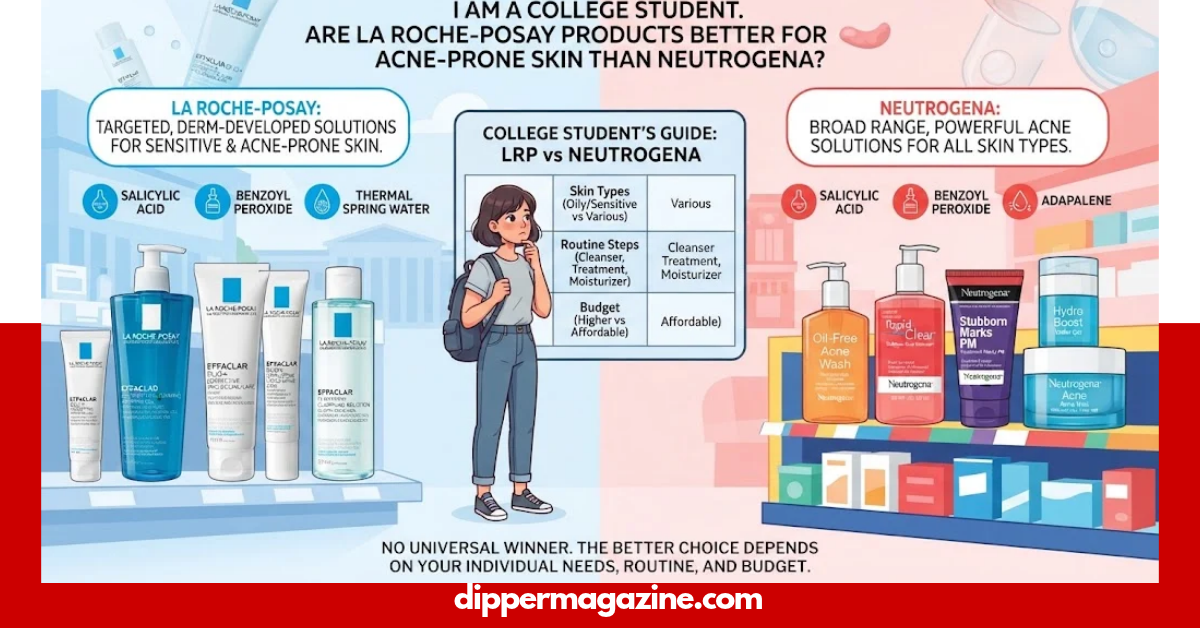
If you are asking, “I am a college student. Are La Roche-Posay products better for acne-prone skin than Neutrogena?”, there is no universal winner. Both brands offer acne products containing proven ingredients such as salicylic acid and benzoyl peroxide.
La Roche-Posay has several Effaclar products designed around acne-prone, oily, and sensitive skin. Neutrogena also offers a broad acne range, including salicylic acid, benzoyl peroxide, adapalene, cleansers, treatments, and moisturizers.
For a college student, the better choice usually depends on your acne type, skin sensitivity, routine, and budget, rather than the brand name alone.
Why This Comparison Matters for College Students
College life can make skincare difficult. Busy classes, late nights, stress, makeup, sweat, and limited budgets can all make it harder to maintain a consistent routine.
If you are wondering, “I am a college student. Are La Roche-Posay products better for acne-prone skin than Neutrogena?”, start by checking the active ingredient instead of choosing a product because it is more expensive or popular.
A simple routine that you can follow consistently often makes more sense than buying several treatments and using them all at once.
La Roche-Posay for Acne-Prone Skin
La Roche-Posay’s Effaclar line includes products specifically made for acne-prone and oily skin. Its current range includes salicylic-acid treatments, benzoyl peroxide treatments, cleansers, toners, and moisturizers.
For example, Effaclar BPO Multi-Target Acne Treatment contains 5.5% micronized benzoyl peroxide. The company says it is designed for whiteheads, blackheads, pimples, and acne blemishes and is tested for acne-prone and sensitive skin.
Its Effaclar Multi-Target Acne Treatment with 0.5% salicylic acid is another option. La Roche-Posay describes it as a pore-focused treatment for blackheads, whiteheads, blemishes, clogged pores, oily skin, and post-acne marks.
Neutrogena for Acne-Prone Skin
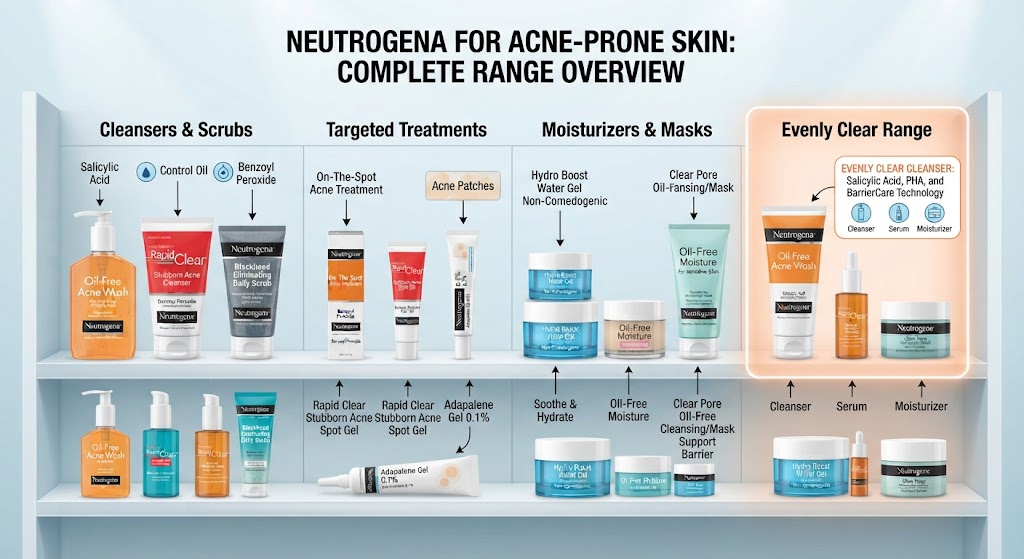
Neutrogena has a large acne range with different types of products. Its current acne collection includes salicylic-acid cleansers, benzoyl peroxide treatments, adapalene, acne patches, moisturizers, and targeted treatments.
That variety can be useful when you want to build a routine around one particular acne concern. For example, Neutrogena lists several salicylic-acid products for acne and oily skin, as well as separate benzoyl peroxide products.
Neutrogena’s newer Evenly Clear range also combines acne-focused ingredients with ingredients intended to support the skin barrier. The company says its cleanser uses salicylic acid, PHA, and BarrierCare technology.
La Roche-Posay vs Neutrogena: Detailed Comparison
| Feature | La Roche-Posay | Neutrogena |
| Acne-focused range | Effaclar | Multiple acne collections |
| Salicylic acid | Yes | Yes |
| Benzoyl peroxide | Yes | Yes |
| Adapalene | Not the main focus of the comparison | Available in its acne range |
| Acne cleansers | Yes | Yes |
| Acne treatments | Yes | Yes |
| Sensitive-skin options | Several products are marketed for sensitive skin | Several sensitive-skin options |
| Oily-skin products | Strong Effaclar focus | Available |
| Acne patches | Available in Effaclar range | Available |
| Product variety | Focused acne system | Very broad acne selection |
| Student-friendly choice | Depends on local price and product | Depends on local price and product |
| Main consideration | Match the Effaclar product to your acne | Match the specific Neutrogena product to your acne |
The important point is that La Roche-Posay and Neutrogena are brands, not single acne treatments. Comparing the brands alone can hide major differences between individual formulas.
Which Ingredients Actually Help Acne?
The active ingredient matters more than the logo on the bottle.
The FDA’s OTC acne monograph recognizes benzoyl peroxide at 2.5% to 10% and salicylic acid at 0.5% to 2% among permitted acne active ingredients.
The American Academy of Dermatology explains that salicylic acid helps unclog pores and exfoliate the skin, while benzoyl peroxide reduces acne-causing bacteria.
Salicylic Acid
Salicylic acid can be useful when clogged pores, blackheads, and whiteheads are major concerns. It helps remove dead skin cells and clear blocked pores.
It is found across both La Roche-Posay and Neutrogena acne products.
Benzoyl Peroxide
Benzoyl peroxide is particularly useful for inflamed pimples. The American Academy of Dermatology notes that it reduces acne-causing bacteria and is commonly used as part of acne treatment.
If you have never used it before, the AAD advises starting with a lower concentration such as 2.5% to reduce the chance of irritation.
Adapalene
Adapalene is a topical retinoid used for acne. Neutrogena currently lists a 0.1% adapalene gel in its acne collection.
Because retinoids can cause irritation when you first start using them, follow the product directions carefully and avoid adding several strong acne treatments at the same time.
Is La Roche-Posay Better for Sensitive Acne-Prone Skin?
If your skin becomes dry, irritated, or uncomfortable easily, you may prefer a product specifically tested or marketed for sensitive skin.
Several Effaclar products are labeled as suitable for sensitive and acne-prone skin. For example, La Roche-Posay describes its 5.5% benzoyl peroxide treatment as suitable for sensitive skin and fragrance-free.
However, “I am a college student. Are La Roche-Posay products better for acne-prone skin than Neutrogena?” cannot be answered from sensitivity alone. Neutrogena also has sensitive-skin and fragrance-free acne options, so check the exact product label before buying.
Which Is Better for Blackheads and Whiteheads?
For blackheads and whiteheads, salicylic acid is an important ingredient to look for.
The AAD states that salicylic acid unclogs pores and works particularly well for whiteheads and blackheads.
Both brands have salicylic-acid options, so compare the individual products rather than choosing a brand automatically.
La Roche-Posay’s Effaclar Multi-Target Acne Treatment contains 0.5% salicylic acid and is specifically marketed for blackheads, whiteheads, clogged pores, and acne blemishes.
Which Is Better for Red, Inflamed Pimples?
For red and inflamed pimples, benzoyl peroxide can be particularly useful.
La Roche-Posay’s Effaclar BPO treatment contains 5.5% micronized benzoyl peroxide. Neutrogena also has multiple benzoyl peroxide acne products, including targeted treatments.
This means the question “I am a college student. Are La Roche-Posay products better for acne-prone skin than Neutrogena?” depends partly on which treatment you are comparing.
A 5.5% benzoyl peroxide product and a salicylic-acid cleanser are designed to address different acne needs.
What Should a College Student’s Acne Routine Look Like?
You do not need a complicated 10-step routine.
Morning
- Use a gentle cleanser.
- Apply an acne treatment if appropriate for your skin.
- Use a non-comedogenic moisturizer.
- Apply broad-spectrum SPF 30 or higher.
The AAD recommends a non-comedogenic, broad-spectrum sunscreen with SPF 30 or higher for acne-prone skin.
Night
- Cleanse your face gently.
- Apply one acne treatment.
- Moisturize.
- Give your skin time to adjust before adding another active ingredient.
Using several strong acne products together can increase dryness and irritation without necessarily giving faster results.
How to Choose Between La Roche-Posay and Neutrogena on a Student Budget
Price matters when you are a student.
Instead of buying an entire acne system, start with the product that targets your main concern. For example:
- Blackheads/whiteheads: consider salicylic acid.
- Red pimples: consider benzoyl peroxide.
- Recurring acne: consider a routine built around a proven acne active.
- Sensitive skin: look for fragrance-free, non-comedogenic options and introduce actives slowly.
- Limited budget: prioritize cleanser, moisturizer, sunscreen, and one acne treatment.
The cheapest product is not automatically the best value. A product you can comfortably use consistently may be more useful than an expensive routine that irritates your skin.
La Roche-Posay vs Neutrogena: Pros and Considerations
| Category | La Roche-Posay | Neutrogena |
| Acne specialization | Strong Effaclar acne focus | Large acne portfolio |
| Salicylic acid | Available | Widely available |
| Benzoyl peroxide | Available | Widely available |
| Retinoid option | Less central to Effaclar comparison | Adapalene 0.1% available |
| Sensitive skin | Many products designed/tested for sensitive skin | Sensitive options available |
| Routine simplicity | Effaclar can form a focused routine | Many choices can be mixed and matched |
| Product selection | Focused | Very broad |
| Best approach | Choose based on acne type | Choose based on active ingredient |
| Student consideration | Compare local cost | Compare local cost |
This table shows why a direct brand-versus-brand answer can be misleading. The specific formula, active ingredient, concentration, skin type, and consistency matter more than the brand name.
Can You Use La Roche-Posay and Neutrogena Together?
Yes, different products from the two brands can sometimes be used in the same routine, but you do not need to combine them simply because they are from different companies.
For example, using a gentle cleanser from one brand and a suitable moisturizer from another can be reasonable. The bigger concern is accidentally combining several acne actives that irritate your skin.
If you already use benzoyl peroxide, salicylic acid, or adapalene, introduce other active products carefully.
What Does the Research Say About Acne Ingredients?
The evidence-based approach is to focus on proven active ingredients rather than marketing claims.
The AAD identifies benzoyl peroxide, salicylic acid, retinoids, and other acne treatments as useful options depending on the type and severity of acne.
The FDA also specifies permitted active ingredients and concentrations for OTC topical acne products.
This supports a practical rule: when comparing two products, read the active ingredients and their concentrations first, then consider texture, irritation potential, price, and convenience.
When Should a College Student See a Dermatologist?
OTC skincare can help mild acne, but persistent or severe acne may need professional treatment.
Consider seeing a dermatologist if:
- Acne is deep, painful, or cyst-like.
- Breakouts are leaving scars.
- Acne keeps returning despite consistent OTC treatment.
- Your skin becomes severely irritated.
- Acne is affecting your daily life.
- You have tried an appropriate routine for several weeks without meaningful improvement.
The AAD notes that deep nodules and cysts can scar and that acne that does not clear with non-prescription treatment may require dermatological care.
Frequently Asked Questions
Not automatically. Both brands offer evidence-based acne ingredients, including salicylic acid and benzoyl peroxide. The better product depends on your acne type, skin sensitivity, routine, and budget.
Yes, the Effaclar range is specifically designed around acne-prone and oily skin concerns. It includes treatments for clogged pores, blackheads, whiteheads, pimples, and excess oil.
Yes. Neutrogena currently offers a broad range of acne products containing salicylic acid, benzoyl peroxide, and adapalene, among other formulations.
Salicylic acid is a strong option for blackheads because it helps unclog pores and exfoliate the skin. The AAD specifically lists salicylic acid as useful for whiteheads and blackheads.
Benzoyl peroxide is commonly used for inflamed pimples because it reduces acne-causing bacteria. Both La Roche-Posay and Neutrogena offer benzoyl peroxide products.
Some acne treatments are designed for daily use, but frequency depends on the active ingredient and your skin’s tolerance. Start according to the product directions and reduce use if significant dryness, burning, or peeling develops.
Conclusion
If you are asking, “I am a college student. Are La Roche-Posay products better for acne-prone skin than Neutrogena?”, look beyond the brand name.
La Roche-Posay’s Effaclar range offers targeted acne products, including salicylic acid and benzoyl peroxide treatments. Neutrogena provides a wider acne portfolio with salicylic acid, benzoyl peroxide, adapalene, cleansers, moisturizers, and targeted treatments.
For a student, the smartest starting point is a simple, affordable routine built around your actual acne type. Check the active ingredient, avoid stacking too many treatments, protect your skin with sunscreen, and give a consistent routine enough time to work.