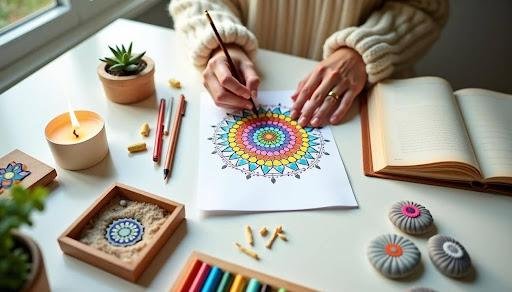
There is a particular kind of tired that comes from a day of constant switching. Emails, messages, meetings, news alerts and a dozen open tabs. By evening, the body is still but the mind keeps running. Many of us try to fix this by scrolling on the sofa, only to feel more wired than before.
An older and simpler remedy is sitting in craft drawers and hobby shops: repetitive, hands-on making. Knitting, colouring, embroidery and dot painting may look like gentle pastimes, but they work on the mind in a surprisingly effective way. Here is why they help, and how to make them part of your routine.
One Small, Clear Task
Repetitive crafts give the mind one small, clear task, which is exactly why they calm us down. Stress often comes from too many open loops: unfinished jobs, unanswered messages, decisions waiting to be made. A repetitive craft replaces all of that with a single action that has an obvious beginning and end. One stitch. One line. One circle. Then the next.
This narrow focus is close to what mindfulness teachers describe as anchoring attention. You are not trying to empty your mind. You are giving it something gentle to hold. When your thoughts drift, the task quietly pulls you back.
The Rhythm Effect
Many people describe a rhythm that settles in after a few minutes of repetitive work. Breathing slows, shoulders drop and time seems to pass differently. Psychologists often link this to the idea of flow, the state where a task is engaging enough to hold your attention but easy enough that it does not cause strain.
The key is the right level of challenge. If a craft is too difficult, you get frustrated. If it is too dull, your mind wanders back to its worries. Repetitive crafts with a visible result sit right in the middle.
Visible Progress, Small Rewards
Much modern work is invisible. You can spend a whole day busy and have nothing to point to. Crafts reverse that. Every session leaves something you can see: a few more rows of knitting, a filled corner of a colouring page, a section of canvas that was blank an hour ago. That small, steady sense of progress is quietly motivating and very satisfying.
Why Dot Painting Works So Well
Dot painting is one of the clearest examples of mindful making. Kits from ohmydotz.nl are built around filling in circles one at a time, with no mixing or planning. The canvas is pre-printed with a pattern of circles, and your only job is to fill each one with a pen. There are no decisions to make about colour or composition, so there is nothing to overthink.
It becomes even more meaningful with a dot painting van eigen foto (dot painting from your own photo). Watching a memory appear dot by dot turns a quiet hour into something personal. Many people choose a picture of a loved one, a pet or a special place, and find that working on it becomes a gentle way of spending time with that memory.
It is also practical. There is no setup or cleanup, so you can sit down for ten minutes without it feeling like a project. That low barrier matters, because the most calming hobby is the one you actually do.
Other Crafts Worth Trying
Knitting and crochet are classics for good reason. The repeated motion is soothing, and you end up with something useful. Embroidery and cross-stitch offer the same steady rhythm in a smaller, more portable form. Adult colouring books are an easy entry point with almost no cost. Even simple tasks like folding origami or sorting beads can have a similar effect.
How to Build It Into Your Week
Keep your craft visible and ready. If it lives in a box in the cupboard, you will reach for your phone instead. Leave it on a side table with everything you need.
Pair it with a cue. A cup of tea after dinner, a favourite playlist or a podcast can become the signal that it is time to make something.
Start small. Ten minutes is enough. The aim is not to finish quickly but to give your mind a regular break.
Put the phone in another room. The benefit comes from single-tasking, and a buzzing screen beside you breaks the spell.
What Gets in the Way
The biggest obstacle is usually perfectionism. Many adults avoid creative hobbies because they believe they are not artistic, or they worry about making mistakes. Repetitive crafts are a good antidote, because the steps are simple and the outcome is guided. You do not need talent, only patience.
The second obstacle is guilt. It can feel unproductive to spend an evening colouring circles or knitting rows. It helps to see it differently. Rest is not the absence of activity but the presence of the right kind of activity, and a calm mind makes you better at everything else you do. Giving yourself permission to make something just for the pleasure of it is part of the practice.
A Calmer Evening Is Within Reach
You do not need a retreat, an app or an hour of meditation to feel calmer. Sometimes all it takes is a simple task, a quiet corner and the willingness to do one small thing at a time. Choose a craft that appeals to you, keep it within reach, and give your busy mind something gentle to hold onto this week.