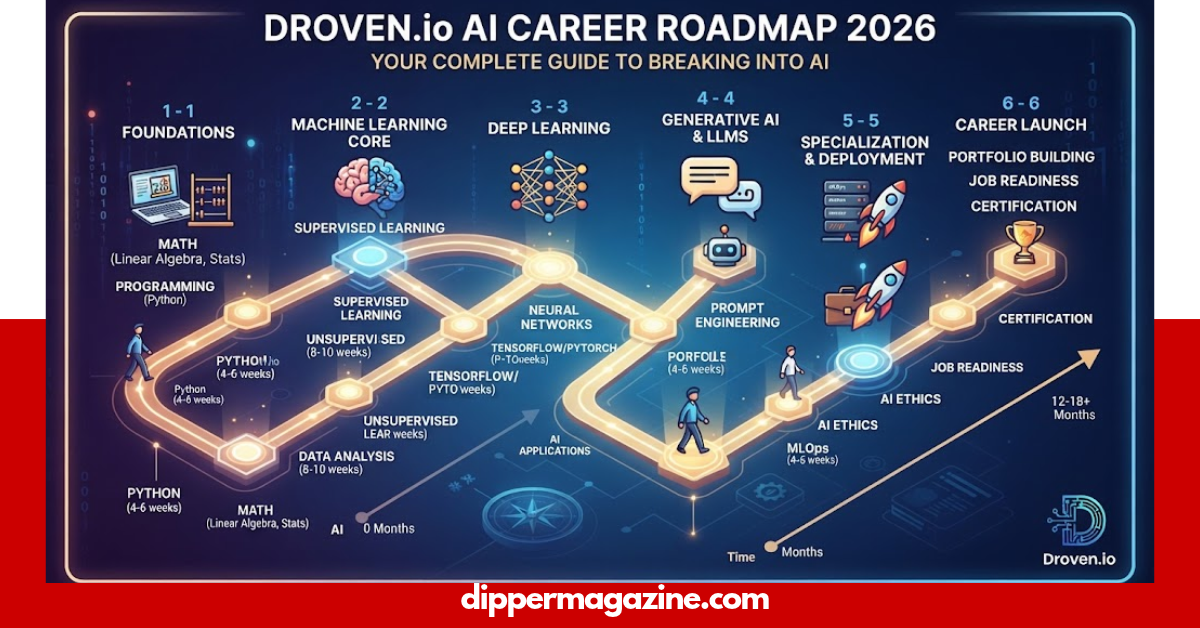
Artificial intelligence is changing the world. Every industry now needs AI talent. But where do you start? The path can feel overwhelming. That’s where the droven.io ai career roadmap comes in.
This roadmap gives you a clear path forward. It takes you from zero knowledge to job-ready skills. No more guessing what to learn next. No more jumping between random tutorials.
The droven.io ai career roadmap is a staged learning system. It covers programming, math, machine learning, and generative AI. Each stage builds on the last. This order matters more than you might think.
Many people try to learn AI without a plan. They watch a deep learning video one day. They try a prompt engineering tutorial the next. Nothing connects. Nothing sticks.
A structured roadmap solves this problem. It creates a logical flow. It helps you build real skills that employers actually want.
In this guide, I’ll walk you through every stage of the droven.io ai career roadmap. You’ll learn what to study, which tools to use, and how long each step takes. Whether you’re a complete beginner or an experienced developer, this roadmap will help you succeed.
What Is the Droven.io AI Career Roadmap?
The droven.io ai career roadmap is a sequenced learning path. It organizes AI skills in a logical order. You start with fundamentals. Then you move to programming. Then math. Then progressively harder AI topics.
Think of it like building a house. You need a strong foundation before you add walls and a roof. The same applies to AI learning. You can’t build advanced models without understanding basic statistics.
The roadmap spans ten stages. Each stage prepares you for the next. This prevents the confusion that comes from scattered learning.
What makes this roadmap different? It’s practical. It focuses on skills that actually matter in the job market. It includes generative AI and AI agents — topics older roadmaps often ignore.
The droven.io ai career roadmap doesn’t replace deep study. You still need to write code and build projects. But it gives you a clear direction. You’ll always know what to learn next.
Who Should Follow This Roadmap?
The droven.io ai career roadmap works for many different people. Let’s look at who benefits most.
Complete beginners with no coding background start at Stage 1. They move through each stage in order. They spend more time on programming and math. This builds a solid foundation.
Career switchers from non-technical roles also start at the beginning. They bring valuable domain knowledge from fields like healthcare or finance. This becomes a major advantage later.
Software developers already know how to code. They can skip ahead to machine learning and generative AI sections. Their main focus becomes math and statistics — often the biggest gap for developers.
Students can use the roadmap alongside their coursework. It fills practical gaps that academic programs often miss. Building a portfolio is especially important for landing that first job.
Freelancers and entrepreneurs might not need every stage. Someone building chatbots may focus on Stages 1, 2, 7, and 9. They can keep a working understanding of the other stages.
Business owners exploring AI adoption often only need Stages 1, 7, and 8. They want to understand what’s possible without building models themselves.
Why a Structured Learning Path Matters
Learning AI without a sequence is a common trap. Many people fall into it. They take random courses. They watch unrelated videos. Nothing connects.
This scattered approach causes real problems. Hiring teams report that candidates with unordered learning histories often struggle more with fundamentals. They may have covered more material. But they can’t apply it effectively.
A structured roadmap like the droven.io ai career roadmap prevents this. Each skill builds on previous ones. You understand why things work, not just how to copy code.
Think about it this way. Would you learn a new language by randomly studying words from different levels? Of course not. You’d start with basic vocabulary and grammar. Then you’d build up to conversations. Then to advanced writing.
AI learning works the same way. You need a logical progression.
The 10 Stages of the Droven.io AI Career Roadmap
Let’s explore each stage in detail. Here’s a quick overview of all ten stages:
| Stage | Focus Area | Key Topics & Tools |
| 1 | AI Fundamentals | AI, ML, deep learning, NLP, computer vision concepts |
| 2 | Python & Programming | Variables, functions, OOP, data structures — Python |
| 3 | Math & Statistics | Linear algebra, probability, statistics, optimization |
| 4 | Data Analysis | Data cleaning, Pandas, NumPy, SQL, visualization |
| 5 | Machine Learning | Supervised/unsupervised learning, Scikit-learn |
| 6 | Deep Learning | Neural networks, CNNs, RNNs — TensorFlow, PyTorch |
| 7 | Generative AI & LLMs | Prompt engineering, RAG, vector databases, LLM APIs |
| 8 | AI Agents & Automation | Tool calling, agent frameworks, workflow automation |
| 9 | Portfolio Building | Real projects — chatbots, dashboards, recommendation engines |
| 10 | Certifications | Cloud AI, ML, and GenAI certificates |
Now let’s break down each stage in more detail.
Stage 1: AI Fundamentals
This stage builds your mental map of AI concepts. You’ll learn what artificial intelligence actually means. You’ll understand machine learning as a subset of AI. You’ll see how deep learning fits under machine learning.
You’ll also explore applications like natural language processing and computer vision. The goal isn’t mastery. It’s just understanding the landscape.
Many people skip this stage. They want to jump straight into coding. This is a mistake. Without conceptual understanding, you’ll struggle later. You’ll copy code without knowing why it works.
Take time to build this foundation. It will make everything else easier.
Stage 2: Python and Programming Foundations
Python is the language of AI. According to Wikipedia, it has become one of the most widely used languages in the AI and machine learning community. This stage teaches you the fundamentals.
You’ll learn variables, functions, loops, and conditionals. You’ll study object-oriented programming and data structures. You’ll understand basic error handling.
Why Python specifically? Its ecosystem of AI libraries is unmatched. Pandas, NumPy, Scikit-learn, TensorFlow, and PyTorch all work with Python. Learning Python opens doors to all these tools.
This stage is essential for everyone. Even experienced developers should review these basics. They form the foundation for everything that follows.
Stage 3: Mathematics and Statistics for AI
Math explains how machine learning models actually learn. This stage covers linear algebra, probability, statistics, and optimization.
You might wonder how much math you really need. The answer: working knowledge, not academic mastery. You need enough to understand why a model behaves a certain way. You need to interpret results correctly.
For most applied roles, deep mathematical rigor isn’t required. Research positions are different. They demand advanced math skills. But most AI engineering jobs focus on application.
Don’t let math scare you away. Start with the basics. Build up gradually.
Stage 4: Data Analysis and Visualization
AI systems are only as good as the data behind them. This stage teaches you to work with data effectively.
You’ll learn data cleaning and exploratory analysis. You’ll spot missing values and outliers. You’ll fix inconsistent formatting. These skills prevent major problems later.
Common tools include Pandas and NumPy for data manipulation. SQL helps you query structured databases. Visualization libraries like Matplotlib turn numbers into clear charts.
Data analysis comes before model building for good reason. Clean data leads to better models. Messy data leads to garbage results.
Stage 5: Machine Learning Fundamentals
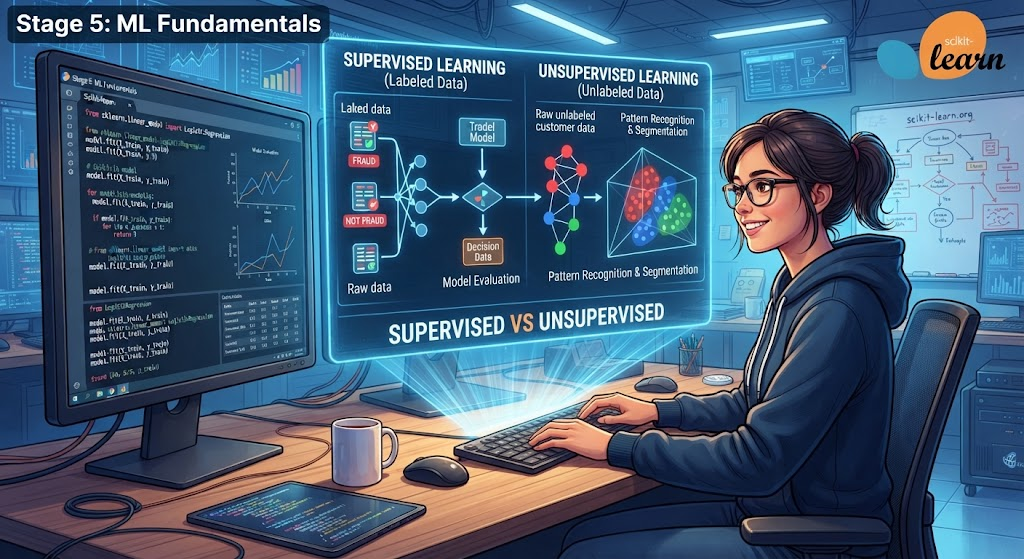
This is where you start building actual models. You’ll learn supervised and unsupervised learning.
Supervised learning uses labeled data to predict outcomes. For example: is this transaction fraudulent? Unsupervised learning finds patterns in unlabeled data. For example: grouping customers into segments.
You’ll work with Scikit-learn, the most popular machine learning library in Python. You’ll learn about model evaluation and selection. You’ll understand which algorithm fits which problem.
This stage transforms you from a programmer into a machine learning practitioner.
Stage 6: Deep Learning
Deep learning uses neural networks with many layers. This stage covers CNNs for image processing and RNNs for sequential data.
You’ll work with TensorFlow and PyTorch — the two dominant deep learning frameworks. These tools power most modern AI applications.
Deep learning enables breakthrough capabilities. Image recognition. Speech recognition. Language translation. This stage gives you the skills to build these systems.
Stage 7: Generative AI and Large Language Models
This is the stage older roadmaps often ignore. But in 2026, generative AI skills are in massive demand. They appear in job descriptions almost as often as traditional machine learning skills.
You’ll learn prompt engineering. You’ll understand RAG (Retrieval-Augmented Generation). You’ll work with vector databases and LLM APIs.
According to Forbes, some generative AI skills now command salaries that outpace what a traditional four-year degree produces. This is why this stage has become so important.
Don’t skip this stage. It’s where much of the current job growth is happening.
Stage 8: AI Agents and Automation
AI agents are autonomous systems that perform tasks. This stage teaches you to build them.
You’ll learn about tool calling and agent frameworks. You’ll understand workflow automation. You’ll build systems that can act independently.
This is a rapidly growing field. Companies want AI agents that handle repetitive tasks. They want automation that saves time and money. This stage prepares you for these opportunities.
Stage 9: Portfolio Building
Theory alone rarely gets anyone hired. This stage is about building real projects that demonstrate your skills.
Common portfolio projects include chatbots, resume screeners, recommendation engines, and predictive dashboards. None of these need to be groundbreaking. They just need to work.
Recruiters often say a working project tells them more in five minutes than a resume does in an hour. Your portfolio is your most powerful job-seeking tool.
Build projects that solve real problems. Be ready to explain your decisions. This is what employers actually care about.
Stage 10: Certifications and Continued Learning
Certifications can supplement your portfolio. They provide formal validation of your skills. Cloud AI, ML, and generative AI certificates are all valuable.
But remember: certifications are not a substitute for portfolio work. They’re an addition, not a replacement.
The AI field evolves quickly. Continued learning is essential. Stay curious. Keep building. Never stop growing.
Estimated Timeline to Become Job-Ready
How long does the droven.io ai career roadmap take? It depends on your background and available time.
Here are typical timeframes:
| Phase | Stages | Typical Duration |
| Foundations | 1–2 | 2–3 months |
| Programming & Data Skills | 3–4 | 4–6 months |
| Machine Learning | 5 | 6–9 months |
| Portfolio Development | 9 | 9–12 months |
| Advanced Specialization & Job Readiness | — | 12–18 months |
Someone coding full-time might compress this significantly. Someone learning part-time around a job usually takes longer.
Consistency matters more than raw speed. Study regularly. Build consistently. Progress will follow.
Career Paths After Following the Roadmap
The droven.io ai career roadmap opens many career paths:
AI Engineer designs and deploys AI systems into production.
Machine Learning Engineer builds and maintains ML pipelines.
Data Scientist extracts insights and builds analytical models.
NLP Engineer builds language-processing applications.
AI Automation Specialist creates AI-powered workflows and agents.
AI Consultant advises organizations on AI adoption strategy.
Not every learner ends up in a pure engineering role. Many land in hybrid positions that mix a bit of each. The roadmap prepares you for all of these options.
Common Mistakes That Slow Down Progress
Avoid these common pitfalls:
Spending months on theory without writing code. You learn by doing. Start coding early.
Avoiding projects because they feel “not ready yet.” You’ll never feel fully ready. Start anyway.
Chasing every new tool instead of finishing one. Focus on depth, not breadth.
Treating certifications as a substitute for portfolio work. Employers want to see what you can build.
Ignoring communication skills. These matter more in AI roles than people expect.
How This Roadmap Compares to Other Learning Options
Self-guided roadmaps like this one tend to be free or low-cost. They give you flexibility. You learn at your own pace.
Bootcamps offer structure and community. But they cost money. They also move at a fixed pace.
University degrees provide depth and credentials. But they take years. They’re expensive too.
The droven.io ai career roadmap offers a middle path. It gives you structure without the cost. It lets you learn at your own pace while following a proven sequence.
Choose the path that works for your situation. But always follow a structured approach. Random learning rarely leads to career success.
Building a Portfolio That Gets You Hired
Your portfolio is your ticket to a job. Here’s how to build one that stands out.
Start with small projects. A simple chatbot is fine. A basic recommendation engine works too.
Focus on quality over quantity. One polished project beats five half-finished ones.
Document your work clearly. Explain your decisions. Show your thought process.
Put your code on GitHub. Make it easy for employers to see your skills.
Remember: employers want to see working projects, not just certificates. Build something real. Show what you can do.
Frequently Asked Questions
No. The droven.io ai career roadmap is designed for people without formal AI education. Many successful AI professionals are self-taught. For most applied roles, demonstrated skill matters more than credentials. Research positions may still require advanced degrees. But engineering and automation roles focus on what you can build.
It depends on your goals. Studying 10–15 hours per week is realistic for most people. Full-time study (40+ hours) speeds things up significantly. Consistency matters more than total hours. Study regularly, even if it’s just an hour a day.
You can, but it’s risky. Understanding basic math helps you interpret model behavior and results. You don’t need to be a mathematician. But you should understand linear algebra, probability, and statistics at a working level. This knowledge prevents costly mistakes.
Python. It’s the dominant language for AI and machine learning. Its ecosystem of libraries is unmatched. Learning Python opens doors to all the major AI tools and frameworks.
You’re ready when you can build working AI projects independently. Your portfolio should demonstrate real skills. You should be able to explain your technical decisions clearly. Start applying when you have 2–3 solid portfolio projects.
Conclusion:
The droven.io ai career roadmap gives you a clear path to an AI career. It takes the guesswork out of learning. Each stage builds on the last. You always know what to study next.
AI skills are in massive demand. Companies across every industry need AI talent. The opportunities are growing every day.
The best time to start was yesterday. The second best time is today.
Don’t wait for the perfect moment. Don’t overthink your first step. Just begin. Start with Stage 1. Build your foundation. Then keep moving forward.
Consistency beats speed. Small steps add up over time. Before you know it, you’ll have real skills and a portfolio to show for it.
Your AI career is waiting. The droven.io ai career roadmap shows you the way. Now it’s up to you to take that first step.