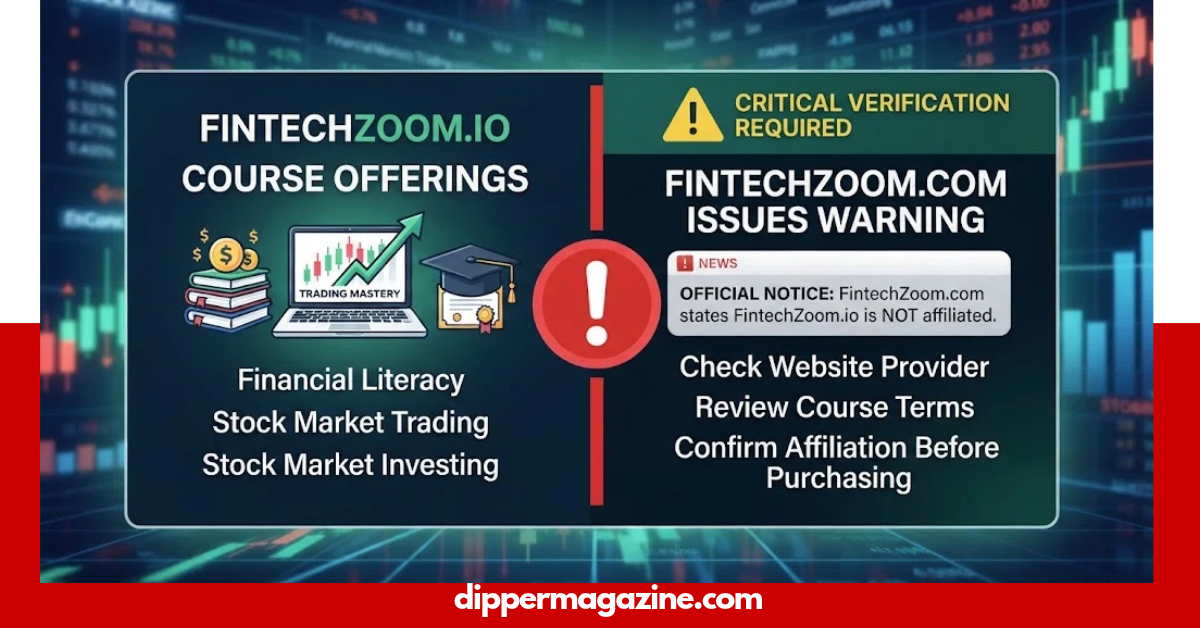
Learning the stock market can feel confusing when charts, technical indicators, trading terms, and investment strategies appear all at once. A structured course can make these topics easier to understand, especially for a beginner who wants lessons in a clear order. The fintechzoom.io stock market course is presented on FintechZoom.io as online financial education covering stock market trading and investing. However, prospective students should verify the website, provider, course terms, and affiliation before paying for any financial education product.
The FintechZoom.io courses page currently lists Financial Literacy, Stock Market Trading, and Stock Market Investing as separate learning areas. Its stock market trading page describes a Trading Mastery Course for new and intermediate traders.
Important verification note: FintechZoom.com identifies fintechzoom.com as its official domain and has published a warning stating that fintechzoom.io is not affiliated with it. This is a material issue that readers should check directly before purchasing anything from the .io website.
What Does the FintechZoom.io Stock Market Course Cover?
The fintechzoom.io stock market course is best understood as a broad search phrase rather than the name of one single course.
The current FintechZoom.io website presents different courses for different learning goals. The trading course focuses on market activity and trading skills, while its investing course focuses more on long-term investing and portfolio concepts.
According to the public course pages, topics include areas such as:
- Stock market fundamentals
- Trading concepts
- Market trends
- Candlestick patterns
- Trading platforms
- Day trading
- Swing trading
- Position trading
- Risk management
- Portfolio allocation
- Trading psychology
- Investment strategies
- Diversification
- Long-term investing
- Index strategies
- Dividend investing
- Market and economic indicators
The exact lessons, instructors, prices, access terms, and course policies can change. Always check the live course page and its terms before making a purchase.
FintechZoom.io Stock Market Course vs. Stock Market Investing
One useful distinction is between trading and investing.
Trading generally focuses on shorter-term price movements and decisions about entering or exiting positions. Investing normally focuses on owning assets for longer periods based on financial goals, company fundamentals, portfolio construction, and risk tolerance.
FintechZoom.io currently separates its stock-market education into trading and investing pages. Its investing course describes subjects such as value investing, dividend growth, passive index strategies, diversification, portfolio management, and risk management.
| Area | Stock Market Trading | Stock Market Investing |
| Main focus | Trading decisions | Long-term wealth building |
| Typical time frame | Short to medium term | Medium to long term |
| Common topics | Charts, trends, trading styles | Stocks, portfolios, diversification |
| Risk focus | Position and trade risk | Portfolio and asset-allocation risk |
| Useful for | People studying active trading | People studying long-term investing |
| Key skill | Market analysis | Research and portfolio planning |
| Common tools | Charts and indicators | Financial statements and portfolio tools |
Neither approach removes investment risk. The right learning path depends on a person’s goals, time horizon, knowledge, and ability to handle losses.
What Does the Trading Course Say It Offers?
The FintechZoom.io stock trading page describes its Stock Market Trading Mastery Course as a program for both new and intermediate traders.
The page says beginners can use the course to learn basic stock market concepts, while intermediate traders can work on trading strategies, analysis, and market patterns. It also mentions practical training, trading platforms, advanced tools, and analytics.
For a beginner, a useful learning sequence would be:
- Understand what stocks represent.
- Learn how stock exchanges and brokers work.
- Understand market orders and limit orders.
- Learn basic chart terminology.
- Study risk management.
- Practice without risking significant money.
- Learn how to evaluate companies.
- Build a written trading or investing plan.
- Review results and mistakes.
- Increase complexity only after understanding the basics.
This approach helps separate learning a skill from simply following a stock tip.
What Is Included in the FintechZoom.io Investing Course?
The investing course page lists a wider range of subjects than basic stock selection.
It describes lessons involving value investing, dividend growth, passive index strategies, portfolio protection, global markets, economic indicators, ESG concepts, options, futures, algorithmic trading, artificial intelligence, and international investing. It also lists on-demand videos, printable worksheets, interactive quizzes, and certification.
The page states that the video material is designed to be completed at the learner’s own pace and describes approximately 7–8 hours of lessons. It also says learners can receive a certificate after completing the course requirements.
Before relying on a certificate, however, readers should distinguish between a course-completion certificate and a professional financial qualification or regulatory license. They are not automatically the same thing.
Who May Find a Stock Market Course Useful?
A stock market course can be useful for people who need a structured introduction instead of trying to learn everything from random videos and social media posts.
The fintechzoom.io stock market course may be relevant to people researching:
- Stock market basics
- Trading terminology
- Technical analysis
- Investment concepts
- Portfolio diversification
- Risk management
- Trading psychology
- Long-term investing
- Market research
- Financial technology
Beginners
Beginners can benefit from learning basic terminology before risking real money.
For example, knowing the difference between a market order and a limit order can help prevent simple execution mistakes.
Intermediate Learners
Someone who already understands basic stocks may want to study chart analysis, portfolio construction, trading systems, or risk controls in a more organized format.
Long-Term Investors
Long-term investors may be more interested in diversification, asset allocation, company research, index investing, and portfolio management than day-trading techniques.
What Should You Verify Before Paying?
This is the most important part of researching the fintechzoom.io stock market course.
FintechZoom.com currently states that its official website is fintechzoom.com and warns about websites using similar domains. Its published warning specifically includes fintechzoom.io among domains it says are not affiliated with FintechZoom.
That does not by itself establish every detail about the .io site’s operators or course quality. It does mean that a buyer should not assume that the .io course is an official FintechZoom.com product simply because the names are similar.
Before paying, check:
| Verification Point | What to Check |
| Domain | Confirm the exact website address |
| Ownership | Look for clear company information |
| Affiliation | Verify whether the brand relationship is genuine |
| Instructor | Check the instructor’s identity and qualifications |
| Curriculum | Review the actual lessons |
| Price | Confirm the final amount before payment |
| Refund policy | Read the cancellation and refund conditions |
| Certificate | Understand what the certificate represents |
| Privacy | Review how personal information is handled |
| Payment | Use a payment method with appropriate protections |
| Support | Check whether a real support channel exists |
| Claims | Be cautious about guaranteed profit claims |
The SEC advises investors to investigate investment opportunities and avoid relying on attractive claims without verification.
Is the FintechZoom.io Stock Market Course Legitimate?
The word legitimate needs to be separated into several questions.
First, FintechZoom.io is publicly accessible and has live course pages describing financial education products. Its website currently publishes course information and market-related material.
Second, there is a significant brand-affiliation question because FintechZoom.com publicly states that fintechzoom.io is not affiliated with it.
Third, a course being available online does not automatically establish that its educational claims, instructors, certifications, or commercial terms meet a particular professional standard.
Therefore, readers should verify the specific product independently before purchasing.
A good rule is simple: do not treat a familiar-looking brand name as proof of authorization.
What Does the SEC Say About Trading Courses?
The U.S. Securities and Exchange Commission has specifically warned investors about fraudulent trading seminars.
The SEC says investors should be cautious when promoters suggest that trading is easy or that a strategy can quickly generate money. It also warns against misleading claims connected with expensive trading classes or software.
This is especially important when a course uses claims such as:
- Guaranteed profits
- Guaranteed returns
- No-risk trading
- Easy money
- Secret strategies
- Immediate financial freedom
- Certain winning trades
A legitimate educational resource should teach the relationship between risk and return, rather than suggesting that losses can be eliminated.
The SEC’s Investor.gov resources also explain that investments involve risk and that investors can lose some or all of their invested money.
How Should Beginners Learn Stock Market Risk?
Risk management should come before complicated trading strategies.
Stocks can rise and fall because of company performance, economic conditions, market sentiment, industry changes, interest rates, and many other factors. Investor.gov explains that diversification and asset allocation can help investors manage risk, although diversification cannot guarantee that an investor will avoid losses.
A simple risk-learning framework looks like this:
1. Understand Your Goal
Know whether you are investing for retirement, a future purchase, education, or another financial objective.
2. Understand Your Time Horizon
Money needed soon may require a different approach from money intended for a long-term goal.
3. Know Your Risk Tolerance
Risk tolerance includes both your ability and willingness to accept losses.
4. Diversify
Spreading investments across different assets and sectors can reduce dependence on one investment.
5. Understand Fees
Trading and investment costs can affect long-term results.
6. Never Risk Money You Cannot Afford to Lose
A course cannot remove market risk.
Why Is Diversification Important?
Diversification means spreading money across different investments instead of depending heavily on one asset.
Investor.gov explains that diversification may reduce the impact of one investment performing poorly, although it cannot guarantee protection during a broad market decline.
For example, a portfolio containing only one company has concentrated exposure. If that company’s business suffers, the entire stock portion of the portfolio can be affected.
A broader portfolio may include different companies, sectors, asset classes, or funds. The exact allocation should depend on the investor’s goals, time horizon, and risk tolerance.
Can a Stock Market Course Guarantee Profits?
No stock market course can legitimately guarantee that a student will make profits from trading or investing.
The stock market involves uncertainty. Even professional investors can experience losses, and past performance does not guarantee future results.
The SEC has repeatedly highlighted the danger of investment offers promising high returns with little or no risk. Its investor education materials emphasize that higher potential returns generally come with higher risk.
A useful course should therefore help students understand:
- Risk management
- Position sizing
- Diversification
- Market volatility
- Research
- Trading psychology
- Fees
- Investment time horizons
- Financial statements
- Decision-making
The goal of education should be better understanding, not a promise of guaranteed profits.
What Skills Should You Gain From a Stock Market Course?
A strong learning program should leave students with practical skills rather than only financial vocabulary.
Here is a useful skills checklist:
| Skill | Why It Matters |
| Market terminology | Helps you understand financial information |
| Fundamental analysis | Helps evaluate a company’s business and financial position |
| Technical analysis | Helps interpret price and volume data |
| Risk management | Helps control potential losses |
| Portfolio construction | Helps organize investments around goals |
| Diversification | Reduces dependence on one investment |
| Trading psychology | Helps identify emotional decision-making |
| Order types | Helps understand trade execution |
| Fee awareness | Helps calculate the real cost of investing |
| Research skills | Helps separate evidence from online claims |
| Scam awareness | Helps identify suspicious opportunities |
| Record keeping | Helps review decisions and improve |
A certificate alone does not demonstrate mastery of these skills. Practical understanding matters more.
How Can You Evaluate the Course Before Enrolling?
Use a simple verification checklist before submitting payment details.
Course Verification Checklist
Step 1: Check the exact domain.
Do not confuse a .com, .io, .net, or other domain simply because the name looks similar.
Step 2: Check the company’s identity.
Look for a clear business identity, contact details, policies, and responsible parties.
Step 3: Check the instructor.
Search for independently verifiable professional experience rather than relying only on claims made on the sales page.
Step 4: Read the curriculum.
Look for specific lessons instead of vague promises about making money.
Step 5: Check the refund policy.
Understand when refunds are available and what conditions apply.
Step 6: Review payment information.
Confirm who receives your payment and whether the checkout page uses appropriate security.
Step 7: Verify brand affiliation.
This is particularly important for the .io domain because FintechZoom.com has published an explicit warning about it.
Step 8: Ignore guaranteed-return claims.
The SEC identifies promises of high returns with little or no risk as a warning sign.
What Are the Main Benefits of Structured Stock Education?
A structured course can provide several practical benefits when its information is accurate and the provider is properly verified.
Organized Learning
Instead of jumping between unrelated videos, students can follow a defined sequence.
Better Vocabulary
Understanding terms such as market capitalization, dividends, volatility, liquidity, earnings, and diversification makes financial information easier to read.
Risk Awareness
Good education explains losses as well as potential gains.
Practice Opportunities
Exercises, worksheets, quizzes, and examples can help turn theory into usable knowledge.
Better Research Habits
A useful course should encourage students to verify financial information rather than blindly follow online recommendations.
FintechZoom.io’s investing course page currently lists videos, worksheets, quizzes, and certification among its course features.
What Are the Risks of Learning From Online Trading Content?
Online financial education varies widely in quality.
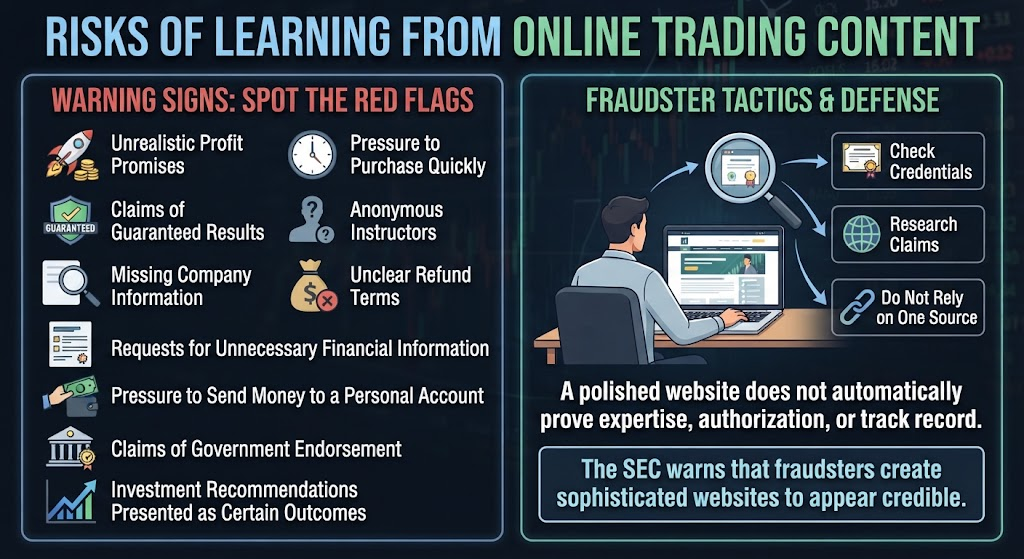
A polished website does not automatically prove that the provider has the expertise, authorization, or track record that a student might assume.
The SEC specifically warns that fraudsters can create sophisticated websites and documents to make investment opportunities appear credible. It recommends researching claims, checking credentials where relevant, and not relying on one source alone.
Watch carefully for:
- Unrealistic profit promises
- Pressure to purchase quickly
- Claims of guaranteed results
- Anonymous instructors
- Missing company information
- Unclear refund terms
- Requests for unnecessary financial information
- Pressure to send money to a personal account
- Claims of government endorsement
- Investment recommendations presented as certain outcomes
Education should make you more careful, not less careful.
What Is the Difference Between Education and Financial Advice?
Financial education explains concepts, tools, risks, and strategies.
Personalized financial advice considers an individual’s financial situation, objectives, tax circumstances, risk tolerance, and other personal factors.
A general stock market course cannot automatically determine what an individual should buy or sell.
Investor.gov emphasizes that asset allocation decisions depend on factors such as time horizon and risk tolerance.
For that reason, students should treat educational material as a starting point for research rather than an automatic personal investment plan.
How Can You Use a Stock Market Course More Effectively?
If you decide to study any stock market course, avoid rushing directly into real-money trading.
Use this practical learning plan:
Week 1: Learn the Basics
Study stocks, exchanges, brokers, market capitalization, dividends, indexes, and basic orders.
Week 2: Learn Research
Practice reading company information, financial statements, earnings reports, and market news.
Week 3: Study Charts
Learn price trends, support and resistance, volume, and basic technical indicators.
Week 4: Learn Risk Management
Study position sizing, diversification, stop-loss concepts, volatility, and portfolio risk.
Week 5: Practice
Use a paper-trading or simulated environment where possible.
Week 6: Review
Record your decisions and identify mistakes before increasing financial exposure.
This approach makes the learning process more measurable and reduces the temptation to treat a course as a shortcut to quick profits.
FintechZoom.io Stock Market Course: Key Facts at a Glance
| Question | Answer |
| What is it? | Online financial education presented by FintechZoom.io |
| Does it cover trading? | Yes, its site lists a Stock Market Trading course |
| Does it cover investing? | Yes, it lists a separate Stock Market Investing course |
| Is it beginner-friendly? | The trading page says beginners are included in its target audience |
| Does it cover risk? | Risk management and portfolio-related topics are described |
| Does it offer videos? | The investing course page lists on-demand videos |
| Does it offer quizzes? | Yes, quizzes are listed on the investing course page |
| Does it offer certification? | The investing course page states that a certificate is provided after completion |
| Is a certificate a professional license? | Not automatically; verify what the certificate represents |
| Is the .io site affiliated with FintechZoom.com? | FintechZoom.com publicly says it is not |
| Should buyers verify before payment? | Yes |
| Does any course guarantee trading profits? | No legitimate education can guarantee market profits |
Course details are based on the public FintechZoom.io pages available at the time of research.
Frequently Asked Questions
Yes, according to the course’s own description, the trading program is designed to include new traders as well as intermediate learners. It presents foundational stock-market concepts before moving into trading strategies and analysis.
The publicly listed topics include stock market fundamentals, trading strategies, chart patterns, market analysis, risk management, trading psychology, portfolio concepts, and investing strategies. The exact curriculum can vary between the trading and investing courses.
Yes. FintechZoom.io currently has a separate Stock Market Investing course covering areas such as value investing, dividend growth, passive index strategies, diversification, portfolio management, and market indicators.
This requires careful verification. FintechZoom.com identifies itself as the official FintechZoom domain and has publicly stated that fintechzoom.io is not affiliated with it.
No. Market returns cannot be guaranteed, and the SEC warns investors to be cautious about trading programs or investment opportunities promising easy or guaranteed profits.
Check the exact domain, company identity, instructor credentials, curriculum, pricing, refund policy, payment details, privacy terms, and any claims about investment returns. Also verify brand affiliation independently instead of relying only on the course website.
Conclusion:
The fintechzoom.io stock market course search term covers financial education products that FintechZoom.io currently presents through separate trading and investing courses. The published material includes topics ranging from market basics and technical analysis to diversification, portfolio management, and investing strategies.
The most important issue for prospective students is verification. FintechZoom.com currently identifies fintechzoom.com as its official domain and has published a warning that includes fintechzoom.io among domains it says are not affiliated with the brand.
Before paying for any financial course, verify who operates it, what exactly you receive, who teaches it, what the refund terms say, and whether the claims can be independently supported. Good stock market education should help you understand risk, research investments, and make informed decisions—not promise certain profits.